Out of the frying pan…

The author and journalist Simon Barnes once observed that in nature conservation, the light at the end of the tunnel often turns out to be an approaching train. These words, wrought from the sort of wry humour that’s a necessity in this line of work, were brought to mind this week following the abrupt conclusion to the breeding season at the Forvie ternery.

The ghost town of the Forvie ternery

After the avian ‘flu debacle of 2023, we entered into the 2024 season with a degree of trepidation, lest the situation should repeat itself. After all, one duff season every now and then isn’t the end of the world for Forvie’s seabirds, but when you pile failure on top of failure, things start to get rather more urgent. In the event, though, not a single case of avian ‘flu was recorded throughout the entire 2024 breeding season. What a relief – and surely some cause for optimism?

Reasons to be cheerful

Well, to some extent yes. In the final analysis, the numbers will show that with the exception of Black-headed Gull, all our key breeding species actually increased in number from 2023 to 2024, despite the horror-show the previous year. The early part of the season was very encouraging, with all species laying good numbers of eggs and enjoying a high level of hatching success. But the breeding season here is a long haul, and it’s not until the young have actually fledged that we can judge the success (or otherwise) of the season as a whole. And despite the promising start, it was late in the piece that we began to notice some very worrying signs. Here, perhaps, was Mr. Barnes’ approaching train.

Something fishy occurring?

As has often been the case in recent years, the early-nesting species – namely Black-headed Gull and Sandwich Tern – had a good solid season, and ended up producing satisfactory, if unexceptional, numbers of fledged young. Neither species seemed to have too much trouble keeping their chicks fed, and the mortality rate at the chick stage was very low (notwithstanding the dreadful weather throughout much of June and early July). However, the smaller species – Arctic, Common and Little Terns – appeared to find life much more difficult.

Arctic Tern against a blue sky – an iconic Forvie summer scene

In the case of Little Tern, we already knew that predation was a problem, with the adult birds having moved their chicks outwith the protective electric fence (excuse me while I face-palm myself). But perhaps more worrying, in the bigger scheme of things, was the situation emerging among the Arctic and Common Terns.

Arctic Terns at their colony

As we’ve explained before, Forvie’s Arctic and Common Terns are dealt with collectively when carrying out the annual nest-census, as their eggs and chicks are so similar in appearance. The proportion of one species to the other in the colony is then determined by means of feeding-counts, i.e. counting the adult birds arriving at the colony carrying fish for their chicks. Usually, the tricky thing about these counts is separating your Common Tern from your Arctic Tern as they rapidly fly past you. This year, however, the problem was not so much identifying each individual bird (this is, in fact, straightforward enough with experience), but rather ascertaining whether the bird in question was actually carrying a food item. Basically, it appeared that most of the fish being brought back to the colony were pitifully small.

The exception rather than the rule – an Arctic Tern with a good-sized fish

In mid-July the breeding colonies of the various species all began to wind down and clear out. This is a perfectly normal process at this stage of the season. But this year, something felt different. Firstly, the scale and speed of the clear-out were remarkable: we went from practically a full-strength ternery to almost complete abandonment within less than two weeks. Secondly – and even more startlingly – the estuary and beach were also devoid of birds. Something was clearly amiss.

An empty estuary

In an ‘ordinary’ season (for if there is such a thing), when the birds clear out of their respective breeding colonies, they relocate to the adjacent beach and estuary. Here they join forces with birds from other colonies which are passing through the area on migration. In recent years it’s not been by any means unusual to count upwards of 4,000 Arctic Terns alone in South Forvie in late summer, with thousands more Black-headed Gulls, Sandwich Terns and others alongside them. It’s one of North-east Scotland’s genuine wildlife spectacles, and over the years many happy hours have been spent trawling through the great flocks to pick out a Roseate or Black Tern, or watching the aerobatic antics of the Arctic Skuas working over the flocks and hoping to steal somebody’s catch.

But this year, nothing. Just an empty beach and an empty estuary. The whole place feels like a ghost town. Danny used the word ‘eerie’ to describe the silence and emptiness of South Forvie this week, and I am inclined to agree with him.

Not a tern to be seen

In trying to rationalise what we were seeing, we started to piece together the information we had, plus snippets from other observers. Chatting to a knowledgeable angler on the Ythan, he remarked upon the paucity of Sea Trout this season both here and on the nearby Ugie Estuary, citing the lack of ‘bait fish’ (Sand-eels and the like) as a reason for the poor showing. Meanwhile, other seabird biologists had noted a similar lack of oily fish being brought in during the second half of the season, with all kinds of weird and wonderful items being substituted (including prawns, flatfish and even insects). It appeared that the change had happened suddenly and abruptly, as if the food supply had been switched off overnight. In the fullness of time, with the completion of the season’s monitoring work at seabird colonies throughout the North Sea, the full picture will be revealed.

Common Tern with its precious catch

At this stage, speculation is rife, but it appears that high sea temperatures in the North Sea have effectively caused the food chain to collapse. Water temperatures affect the distribution and abundance of plankton, which in turn affect the small fish (most notably Sand-eels), which in turn affect the higher predators – whether terns, trout or marine mammals. What we don’t know is whether this is a temporary blip, or a sign of things to come.

A dropped Sand-eel – a photo taken in a previous season

It’s easy to think of climate change as something that may-or-may-not have some sort of vague effect upon everyday life. Sure, some faraway places might get flooded, or other places burnt up by wildfires, or Polar Bears might have to swim further between ice floes, or whatever. To many ordinary folk, these things might seem abstract and irrelevant. Ultimately, though, the impacts of a changing climate will affect all and sundry. Rachel Carson famously wrote of a silent spring, with regard to the effects of agricultural chemicals in the 20th Century. But the thought of a silent summer along our coasts, as a result of climate change in the 21st Century, is similarly heartbreaking.

Please don’t go!

In summary, then, the 2024 seabird season appears to have been a case of out of the frying pan and into the fire. Having recovered from the carnage of avian ‘flu in 2023, we now find ourselves in the situation I had been dreading for the past seventeen summers, with the collapse of our seabirds’ food supply. What remains to be seen is whether the events of recent weeks are an anomaly, or turn out to be the new normal.

Fingers crossed, already, for 2025!
Marvellous Moths and Midsummer Mayhem

Regular readers of this blog may occasionally have picked up on the feeling that midsummer isn’t our favourite time of year. And, right enough, it’s a season that is full of ambiguities. Everything is growing, or breeding, or visiting – and cutting, counting or just generally managing all this means you often don’t have the time to enjoy what can otherwise be a really rewarding time of year. The weather hasn’t been great either, which has even meant we can’t do things like run the moth trap of a night to see what’s out there. But it improved, however briefly, in time for our moth morning on Wednesday.

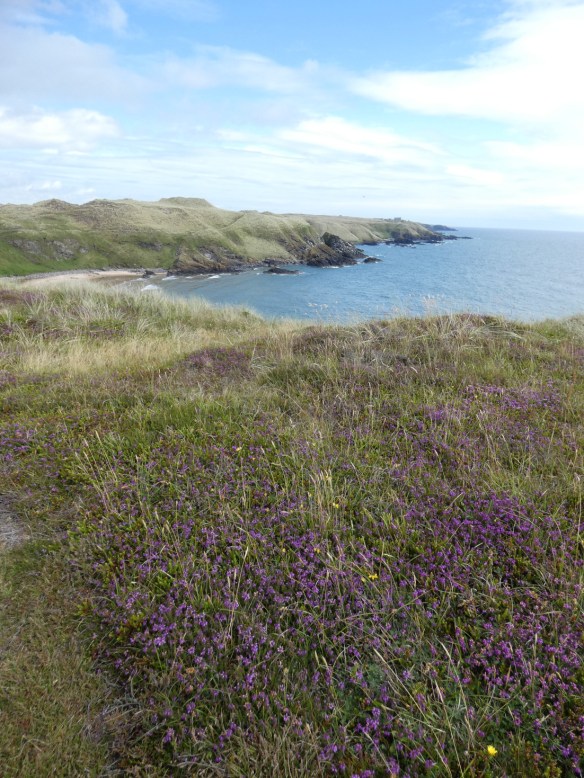
The heather is out, on a rare sunny day at Hackley Bay

We weren’t too optimistic the previous evening, as we went about setting the traps in the pouring rain. But when the morning came, what a haul of moths we had! Admittedly, some are hard to tell apart – which is why we had Helen from Aberdeenshire Council Ranger Service with us, as our local expert – thanks Helen, we couldn’t do it without you!

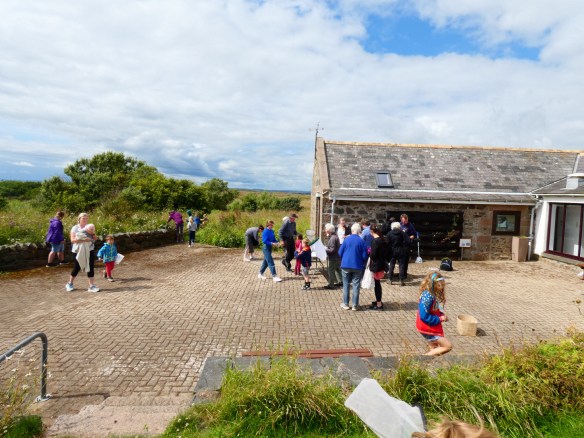
The Marvellous Moths event in full swing

It’s amazing how easy it is to overlook moths – not least because most of them fly at night – but they are vital to our ecosystem. They probably are more important pollinators than even bees, and many are easily as beautiful as butterflies. So how can we find out what’s out there?

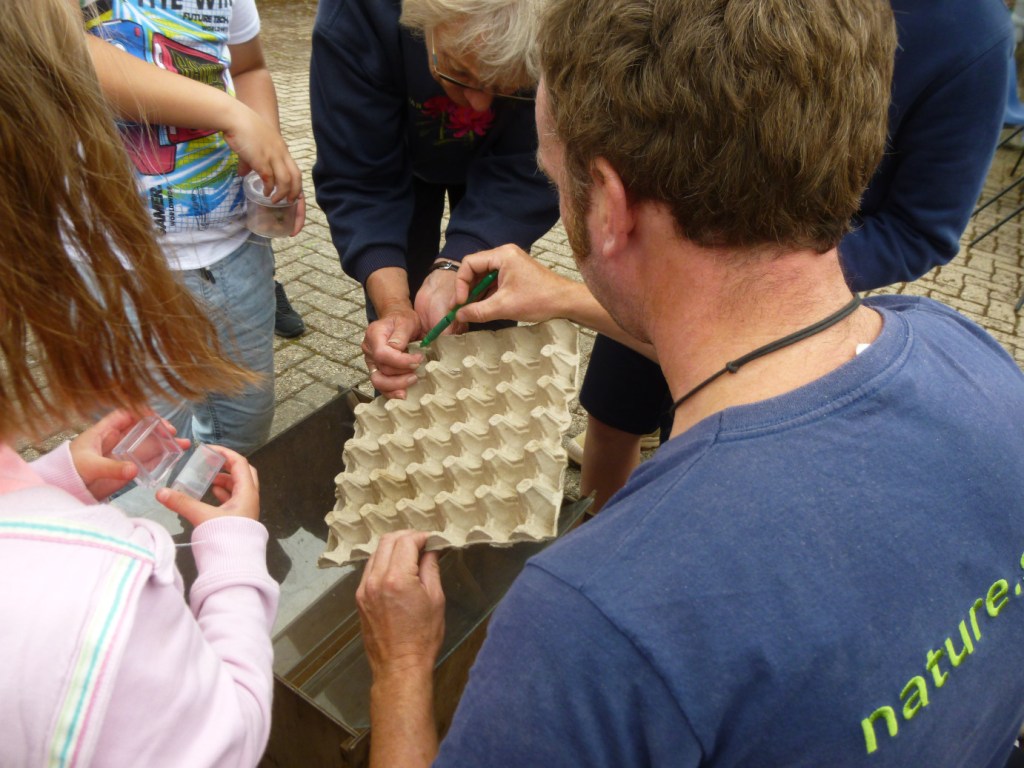
One of the easiest ways for us to come into contact with night-flying moths is by the use of a light trap. This is a simple device comprising a light source mounted on top of a catching-box with a funnelled entrance, rather like a lobster-creel. The moths are attracted by the light, bump into the plastic cover over the lamp, and drop into the box through the funnel. The catching-box is filled with old cardboard egg-boxes, where the moths can safely go to roost until the trap is opened and inspected the following morning. Best of all, the trap does its work while we’re safely tucked up in our beds, meaning we don’t have to stay up all night to see the moths. What’s not to like?

A home-made light trap

The light trap doesn’t harm the moths in any way, and once they’ve been inspected, identified and logged, they are released back into the environment to continue with their lives. Record-keeping is important, because it means that through our moth-trapping activities, we can contribute to scientific knowledge and thus nature conservation. Here at Forvie, all our moth records contribute to the impressive archive held by the North-east Scotland Biological Records Centre (NESBREC).

Equally importantly, moth-trapping is a huge amount of fun. Each time we run the trap, the next morning is like a childhood Christmas Day. The trap is like an unopened present, and there’s the excitement of not knowing what’s going to be in there, added to the possibility of seeing new, exciting and beautiful species. And you never stop learning and discovering.

Opening a moth trap

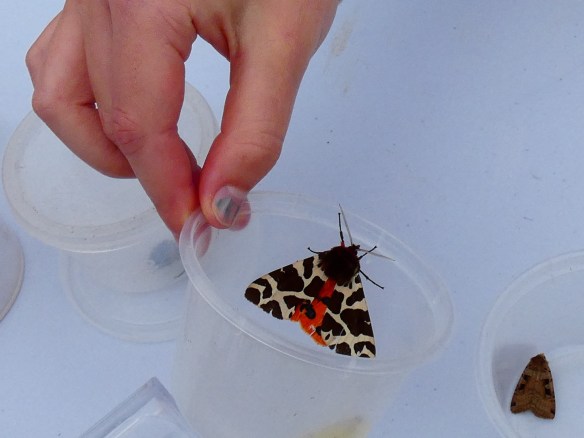
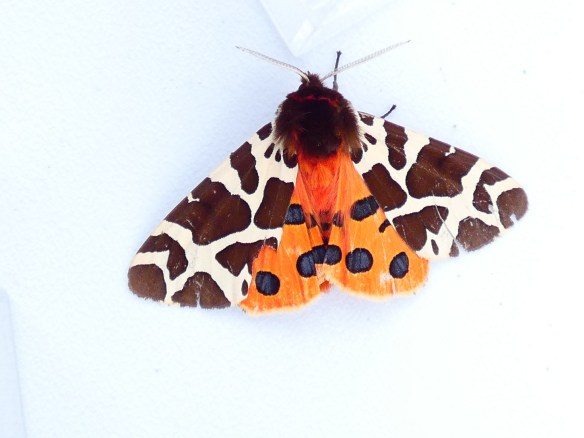
One of the commonest moths – and most easily recognised – is the Garden Tiger. With its black and white upperwings and red underwings, this is an unmistakable beast – and always a real crowd-pleaser on a moth morning.

Garden Tiger
What a beast!

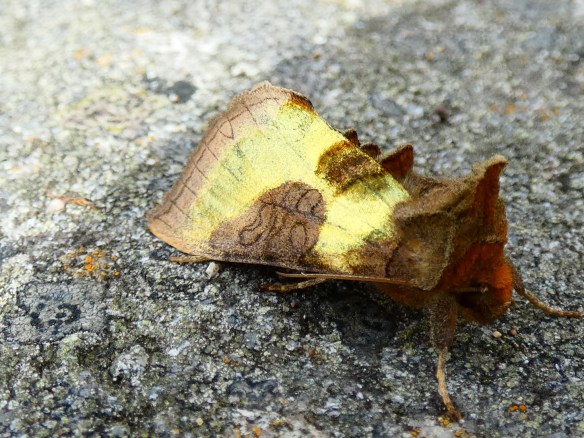
A personal favourite is the Burnished Brass moth. Both moths and butterflies belong to an order called ‘lepidoptera’, which means ‘scaly wings’. Ever tried to handle a moth, maybe to evict it from the house? You probably noticed that there was moth dust everywhere. This would have been scales, shed from the wings and it is these scales which give moths – and butterflies – all the colours and patterns on their wings. Depending on how the light catches them, they can even look like polished metal – pretty impressive!

Burnished Brass

The variety of shapes and colours just seems endless, and here’s a sample of a few other species we had in the moth trap.

Dark Tussock
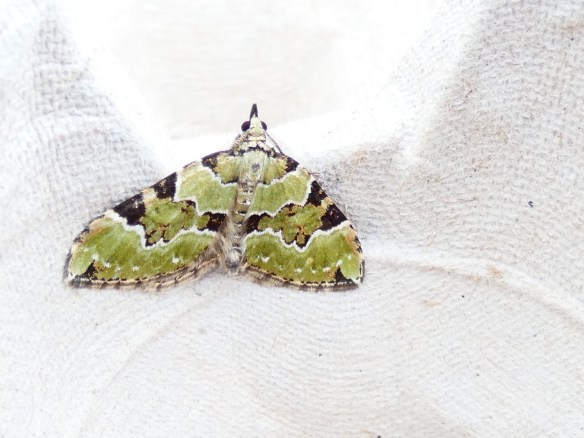
Green Carpet
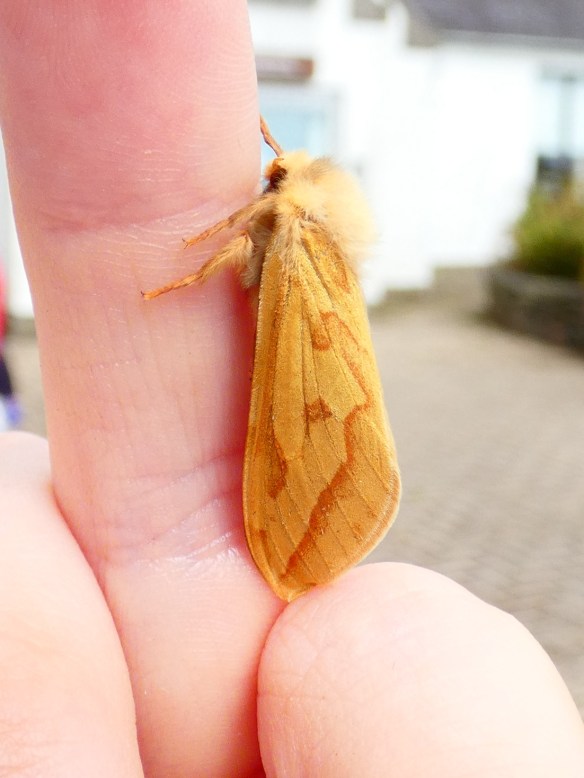
Ghost Moth (female)

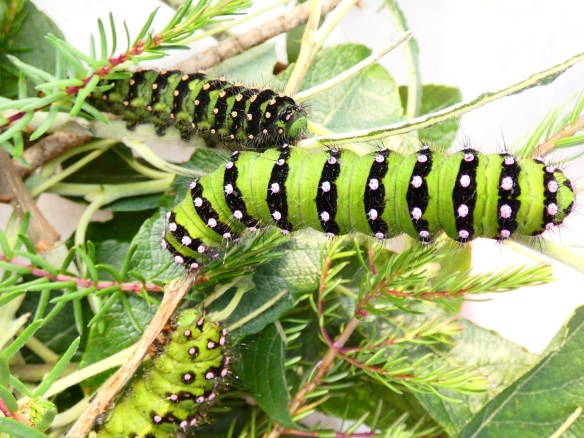
Of course, many of us probably encounter butterfly and moth life cycles at an early age, with books like ‘The Very Hungry Caterpillar’. Well, we also had some impressively hungry caterpillars to show everyone, the startlingly green-and-black striped Emperor Moth caterpillars. Resembling nothing so much as miniature motorised gherkins, these finger-sized caterpillars were almost ready to pupate. They turn into a large and beautiful moth which only lives for about a week – remarkably, the adults have no mouthparts, so can’t actually feed – so they have to do all their eating as caterpillars!

Emperor Moth caterpillars

In fact, I suspect a lot of us encountered insects more when we were younger, not only because we were shorter and nearer the ground to see them, but because children are often just interested in ‘beasties’. After we emptied the moth traps, we went for a minibeast hunt and I think the staff enjoyed it as much as the children!

Minibeast hunt in progress

We’ve actually had a pretty busy week for events, with our Fun Day last week, a gardening-for-wildlife talk on Tuesday and then the moth morning… lots of people, lots of chat, and always great to see and hear folk enthusing about nature. The next event coming up here is the Incredible Invertebrates Minibeast Hunt being led by Caitlin from Buglife – maybe see you there!

Fun at the Fun Day

Away from the people-oriented site of the job, life on the reserve is also proceeding at a frenetic pace. It’s getting quieter down at the ternery now, with may of the young having fledged and left the estuary. But, on a positive note, we do have to print a correction from last week’s blog….a count of ‘commic’ (Common and Arctic tern fledgers) also turned up one Little Tern fledgling. Goodness knows where it has been hiding but at least it has managed to avoid getting eaten! The appearance of this sole survivor was met with some colourful language on the part of the Reserve staff, along the lines of “where the sam hill did you come from?!”

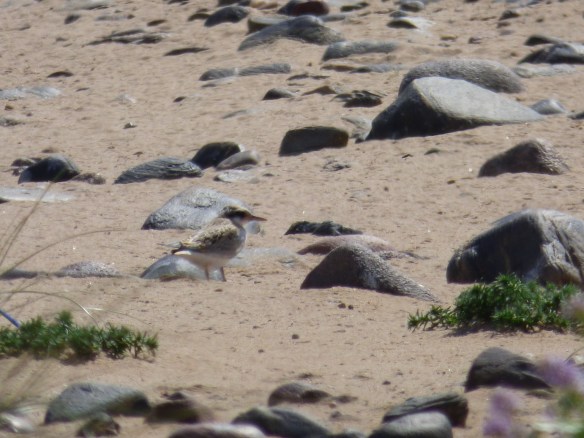
Little Tern fledgling

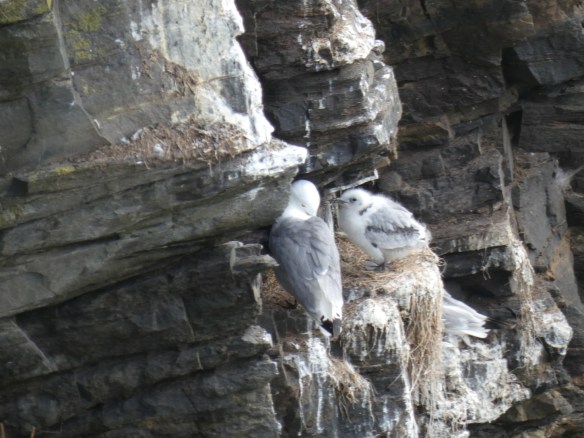
The cliff-nesting seabirds are usually later in the year than the ground-nesters to fledge. Guillemots seem to have had a really poor year and we know the numbers of Kittiwakes are down too (both probably as a result of bird ‘flu last year). But, on the plus side, good numbers of those Kittiwakes that have actually nested this year seem to have half- to two-thirds-grown young.

Kittiwake with chick

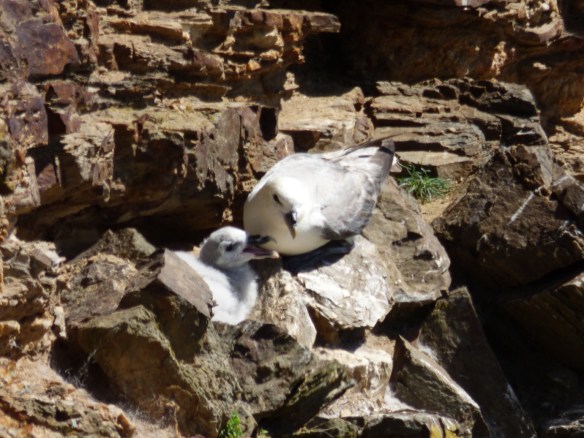
We could also see a couple of fat Fulmar chicks on ledges, too. These are the slowest-growing of any of the birds that breed here and it will take a Fulmar chick about seven weeks from hatching to its first flight. By contrast, all of our terns and gulls will do this in a month or less…but, then again, it’s a lot more dangerous nesting on the ground than on a cliff, and the quicker you can fly, the better!

Fulmar with chick

What a contrast between the frenetically-fast life-cycle of the moths, buzzing through life at 100 mph, and the laid-back and languid pace of life lived by Forvie’s Fulmars. During this period of midsummer mayhem, I know whose lifestyle I would prefer given the choice!

Midsummer monsoon

The long wet summer of 2024 continued true to form this week, and for much of the past few days at Forvie it’s felt more like November than July. Things reached their nadir mid-week, and from Tuesday evening until Thursday morning we endured a relentless 36-hour downpour, accompanied by a 40-odd-mph north-wester and its associated windchill. Good job we never put away our winter togs.

A rain-soaked and sombre South Forvie

While this is annoying for those of us who work outdoors – I went through two complete changes of clothes on Wednesday (so much for ‘waterproofs’) – it’s a matter of life and death for our wildlife. At the ternery on Thursday I found several Black-headed Gull fledglings that had succumbed to exposure, still tucked under the sodden tussocks of grass where they had sought shelter from the monsoon. These losses can seem doubly cruel: firstly for the lives cut short having barely begun, and secondly because in each case the parent birds had done all the hard work in raising their young to fledging, only for them to fall at the last hurdle. But when all’s said and done, that’s just nature: the weather will always have a major influence on the survival and breeding success (or otherwise) of Forvie’s wildlife.

Another victim of the cold and wet summer

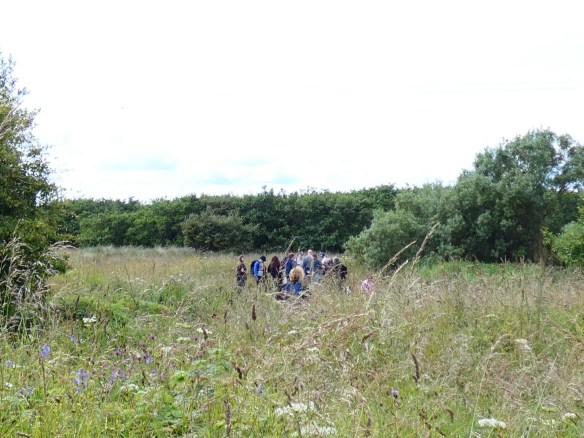
We were actually very fortunate that our Wildflower Walk public event fell on one of the periodic breaks in the weather. In fact we were treated to a really uncharacteristically fine afternoon for the event, and a turnout of 28 attendees was an excellent result. Notwithstanding the dreadful weather for much of July so far, now is a great time to go looking for wild flowers at Forvie, and many of the more colourful species can be seen right alongside the footpaths. During the course of the event, our tour around the inner Heath Trail found the following and many more besides.

Bluebell after the rain
Eyebright
Wild Thyme
Red Clover
Heath Spotted Orchid

Some of the plants that we associate with the second half of summer are also now beginning to come into flower, albeit slowly and reluctantly. One such species is Creeping Thistle, a plant with a bad reputation among gardeners and landowners as a ‘weed’ or ‘nuisance’. But for all that, it’s an important and popular source of nectar for pollinating insects, and is a particular favourite of Forvie’s Dark Green Fritillary butterflies.

Creeping Thistles with butterflies in attendance
Dark Green Fritillary on Creeping Thistle

Another butterfly species increasing in prominence just now is the Ringlet. If you see a smallish, dark-chocolate-coloured butterfly flitting slowly through the tall grasses in North Forvie, or along the track down the estuary-side, it’ll be one of these. Ringlets tend to rest with the wings held in the closed position, and if you’re lucky enough to find one at rest, you might be able to see the series of gold-and-black rings which give the species its common name.

Ringlet

Mid-July is accounting-time for us when it comes to our breeding birds. This is the peak fledging time for many species, and the race is on to count and record them all before they disperse into the wider world. This is the point when we find out how successful all our efforts have been over the past four months, in trying to give the birds the best possible chance of success. All the hard slog – maintaining and repairing the fences, changing the 32kg-each batteries, engaging with the visiting public, and fighting the daily battles against weather / predators / encroaching vegetation – leads to this defining point of the season.

The numbers we record will feed into local and national databases, and thus be retained in the archives long after the staff who entered the data are gone and forgotten. This is one aspect of our work at Forvie that transcends the boundaries of Reserve, region and country, and indeed time itself. It’s ironic, therefore, that finding the time to carry out the work is our biggest problem, with fledgling counts being crammed into the short windows-of-opportunity between poor weather, public events and various other commitments.

Counting fledglings on the estuary

Most of our fledgling counts are carried out from the Newburgh side of the river, which affords good views of the shore adjacent to the ternery, as well as having the advantage of the sun being behind the observer(s) for the most part. Often the biggest problem for visibility is heat-shimmer (curiously even on the cold and indifferent days we’ve experienced for most of this season), and this is apparent in the image below. This photo is a fairly typical representation of what we actually see through the telescope from across the estuary.

In a scene like this, we’d usually be looking to count the Black-headed Gull and Sandwich Tern fledglings (3 and 6 respectively in this picture), while filtering them out from all the other birds on the shore – which in this case comprise several adult Black-headed Gulls and Sandwich Terns, plus a Common Tern and a migrant Roseate Tern for good measure. See if you can pick them all out for yourself – then multiply this scene by a hundred, and you’ve got a good idea about what the job entails.

A typical view through the ‘scope

Our Black-headed Gulls and Sandwich Terns are just past their peak fledging periods, and our attentions will now shift accordingly towards the smaller species. Common and Arctic Terns are now beginning to depart the colony in numbers, and these will be the focus of our counting efforts for the next week or two.

Arctic Tern fledgling

Sadly there won’t be any fledgling counts required for our Little Terns. Despite a promising start to the season, and a good hatch of chicks during June, post-hatching survival was very poor – not helped by the parent birds moving their chicks outside the protective electric fence, leaving them open to the depredations of Foxes, Badgers, Carrion Crows et al. This is the sort of stuff that makes Reserve staff tear out what remains of their hair – you can take a horse to water and all that.

As of last week we were down to just two surviving chicks, and having seen no further activity this week, I carried out a check of the area on foot. Here I found the remains of the last chick, having been killed and eaten by some predator. Thus, sadly, concludes the Forvie Little Tern breeding season for 2024.

A sad end to the Little Tern season
Better luck next year!

A couple of lighter points of trivia on which to finish. The first of these concerns a television interview that reserve manager Catriona gave to STV News on Monday, to discuss the now-live public consultation for the Forvie NNR Management Plan. This is the chance for everyone with an interest in Forvie to have their say on the Reserve’s future management – check out this link for more.

Catriona with the STV crew
Filming in progress

The second is a quick plug for another of our public events. On the evening of Tuesday 16th July, we’re putting on an illustrated evening talk about gardening for wildlife, entitled Build Your Own Nature Reserve. This tells the story of your author’s garden on the north-eastern corner of Forvie, which started off as a barren expanse of gravel and has ended up as a proper little wildlife hotspot – and how you could do the same. It’s a ripping yarn, but then I would say that!

Blackcap on autumn apples – a garden favourite

It’s worth noting, too, that this is an indoor event – so it shouldn’t matter if we end up getting yet another midsummer monsoon. Check out this link for more – and we’d love to see you there.

Ringing the changes

In the wider world outside Forvie, this week’s news was predictably dominated by matters of politics. Such things do, of course, affect nature: the policies of the world’s various governments ultimately dictate much of what happens on the ground, in terms of both conservation and destruction, all over our small planet. But those of us working on the ‘green front line’ don’t tend to get too invested in the convolutions of politics. It’s not our business to worry about constitutional and bureaucratic trivialities; ours is to knuckle down and concentrate on the small matter of conserving the very biosphere upon which humanity depends. No pressure then.

Getting on with the day job

While politics usually concerns itself with the immediate future, or at least a cycle of a few years at a time, our work is relentlessly focused upon the long-term. By way of an example, all the effort we put in at the ternery each summer is to try and ensure that there are still seabirds in the world, not just for the next governmental term of office, but in perpetuity – or at least until evolution replaces them with something else.

An investment for the future

They, and we, haven’t had the easiest of seasons so far. The dreadful cold and wet spring has been succeeded by a similarly poor summer up to this point; not good conditions for small fluffy chicks. Added to that, the vegetation cover in the ternery is becoming so dense as to exclude the birds from large areas of the enclosure, leading them to start nesting on the very fringes where we maintain a pathway around the electric fence. Indeed, some Arctic and Common Terns have been laying eggs immediately outside the fence; these don’t tend to last more than a few days before being mopped up by the various predators – chiefly Badgers and Foxes – that patrol the area nightly. In future we’ll likely have to look at what options are available to try and improve conditions within the enclosure, if indeed we can.

Arctic Terns nesting just inside the fence
A nest outside the fence – good luck with that!

In recent years, the Badger has replaced the Fox as the predator that causes the Reserve staff the most hair-tearing and sleepless nights. These superbly adaptable mammals are thriving in the wider countryside, and are now common throughout the Reserve, including in the southern dunes where the terns, gulls and Eiders nest. Badgers are immensely strong and powerful diggers and earth-movers, and consequently very difficult to fence out.

The electric fence around the ternery is not (and neither could we hope it to be) 100% effective at keeping Badgers out. It does deter the majority of attempts to get in – viz the photo below…

A failed break-in

…but not all of them. We were disappointed to find evidence of a break-in on Friday morning, with an Arctic Tern fledgling found killed nearby, and several clutches of eggs also predated.

Badger work – note the dead fledgling (right of picture)

While this stuff is hard to take for those of us who put a good deal of blood, sweat and tears into maintaining the fence and trying to protect these vulnerable birds, we have to accept that a degree of predation is quite natural for any mainland seabird colony. And there remain plenty of surviving chicks rapidly approaching fledging-time. Fingers crossed that they make it without too many further alarms.

Hurry up and fledge, dammit!

Down on the estuary, the seasons are fairly ringing the changes. Our Eider drakes are now all in their ‘eclipse’ plumage, wherein they lose their bright colours in readiness for moulting out their flight-feathers. During this period they are flightless for a few weeks until they’ve grown a new set of primaries (the large feathers that form the outer part of the wing, and generate most of the lift). So the duller-than-usual plumage helps make them less conspicuous, keeping them safe from predators during this period of vulnerability. Seeing big gangs of ‘eclipse’ Eider drakes sulking on the sand-bars is a real sign of summer moving onwards.

Eclipse Eider drakes

Another sign of the change afoot at this time of year is the appearance on the estuary of southbound wading-birds. Curlew are one of the first species to appear in numbers, and their haunting calls sound especially melancholy at the end of the breeding season. It’s likely that many of these early migrants will be failed breeders, and their quavering and evocative voices sometimes seem to be mourning missed opportunities. These too are a species in trouble, and we wish them better luck next year.

Curlew arriving from the north

While autumn may be at hand in the bird world, we’re still very much in high summer when it comes to plants and insects. The vibrant carpet of wild flowers in the dune-slacks is positively buzzing with bumblebees, butterflies and Six-spot Burnet moths, which appear to be everywhere just now.

Six-spot Burnets – super-abundant

There are plenty of flowers to go around – various daisies, hawkweeds, thistles and clovers carpeting the ground with colour and available nectar – but that didn’t stop a colourful showdown between a Six-spot Burnet and a Common Blue butterfly over a particularly desirable flower. Given the small size and high speed of the participants, Catriona did well to capture this very colourful dispute on camera.

Flower fight!

This is a great time of year for moth-trapping using a live-capture light trap, and as ever, it’s a real eye-opener as to what’s out there beyond our usual sphere of vision. Whether at home or on the Reserve, opening the moth trap is a very agreeable accompaniment to your breakfast-time cuppa.

Moth-trapping with a nice cup of brew

The number and variety of moths in high summer is superb, though there are indisputably a lot of similarly brown-and-cryptic species on the wing that can be a bit of a headache for the beginner. Others, however, are nice and easy to recognise – such as the examples in the following photos. The problem this summer, though, has been finding a rain-free night upon which to run the trap!

Flame Shoulder
Magpie
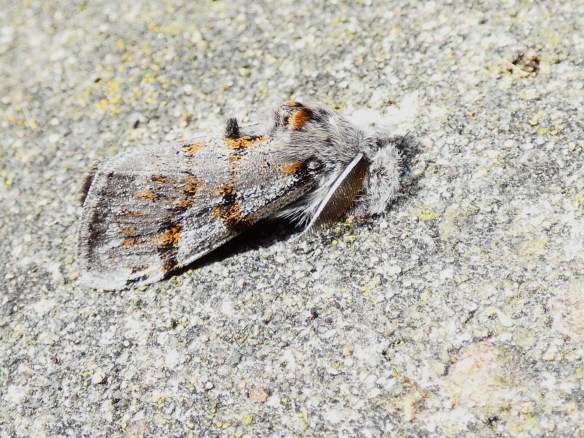
Buff-tip

On another damp and dreich morning, we happened upon a very soggy Meadow Pipit fledgling, who was too damp to fly away but otherwise appeared to be in good health. Meadow Pipits are one of the ground-nesting birds whose welfare we try to safeguard throughout the Reserve during the summer (not least via the oft-repeated and oft-ignored ‘dogs on leads please’ message). So this little pipit-baby got its photo taken, with a view to acting as an ambassador for Forvie’s ground-nesting songbirds in future campaigns.

Meadow Pipit fledgling
“Please behave on the Reserve, or cute chicks like me die. Thanks!”

How do you follow that then? While wondering how to conclude this week’s piece, the answer was given to me by this Scorpion Fly, which helpfully landed upon my screen. I do love it when the wildlife comes looking for me, rather than the other way around.

Scorpion Fly having a read of the blog

They say a week in politics is a long time, but that’s of no concern to a Scorpion Fly. These strange-looking but harmless beasts, which curiously feed on dead insects stolen from spiders’ webs, have been around in much the same form for a cool 250 million years. Quite some term of office.

Two hundred and fifty million years. Now that’s what I call long-term thinking.

Half-time oranges

Although in terms of number of days it’s one of the year’s shorter months, June invariably feels like the longest month of the year on the Reserve. This is due in part to the relentless daylight, which at our latitude extends to 20-plus hours at its peak, and the corresponding sense of urgency in the natural world. It’s the month where nothing seems to sleep or slow down; a loud, brash, exuberant, exhausting carnival of activity.

Living and working on a site like Forvie, you can’t help but get swept along by it, but at the same time, it’s often something of a relief when the end of June comes around. The halfway point of the year is a good time to take a quick breather and take stock of what’s happened so far in the crucial summer season, while looking ahead to the next few critical weeks.

Half-time in the mayhem of summer

At the ternery, things already have a second-half feel to them. Black-headed Gull fledglings are now leaving the colony in numbers, with individuals and small groups of them appearing all over the estuary as they set out on their individual journeys through life. Many more remain in the colony, their flying skills not quite up to the job yet, and we see many aborted maiden flights and ignominious crash-landings among the tall grasses. Tern guru Alistair Smith used to call these half-fledged birds ‘Orvilles’ (presumably after one half of the Wright brothers, rather than the eponymous duck of 1980s television fame), and the term remains in common use among Reserve staff.

A newly-fledged ‘Orville’

Monday past saw our first Sandwich Tern fledgling of 2024 take to the wing, marking the ‘beginning of the end’ of the tern season. As with the gulls, there are many hundreds more in the colony approaching the point of fledging, and before long we’ll hopefully start to see the large, noisy flocks of fledged juveniles and their attendant parents on the lower estuary.

Sandwich Tern chick – growing up fast

After a very slow start to the season, it was with some relief that we started to see some reasonable creches of Eider ducklings on the estuary this week. Having seen only half a dozen ducklings by the time the summer solstice came and went, we’d started to fear the worst. After all, it would be completely in keeping with the idiosyncrasies of Forvie’s Eiders if they followed up a brilliant breeding season in 2023 with a total disaster in ’24. However, the 60 ducklings recorded on Thursday by volunteer Richard and reserve manager Catriona represent a solid start – hopefully with plenty more to come.

Eider mum and her brood

The half-time oranges to which I referred in this week’s title are our Dark Green Fritillary butterflies. These start to emerge en-masse at the halfway point of the year, and will be abundant throughout July and into August. The ‘dark green’ appellation refers of course to the colour of the underwing, which isn’t often seen as the butterfly tends to feed and rest with wings held open. So on the face of it, the name seems utterly daft: this is clearly and unequivocally an orange butterfly and not a green one.

Dark Green Fritillary
‘Dark green’ on the underwing only!

Three other butterfly species made their 2024 debuts this week: Common Blue, Meadow Brown and Small Heath. All of these can be seen throughout the Reserve, with the Dune Trail being a particularly good bet for all three. The Common Blue is easily identified, with no other species of that colour occurring on-site.

Common Blue

The others are a little trickier, but not difficult to sort out given a half-decent view. Essentially, the Small Heath resembles a miniature (barely half-sized) Meadow Brown, with clearer and brighter colours. Both species tend to feed and rest with their wings closed (unlike the aforementioned Dark Green Fritillary), and they share a similar set of markings on the underwings, including those lovely black-and-white ‘eye spots’.

Meadow Brown
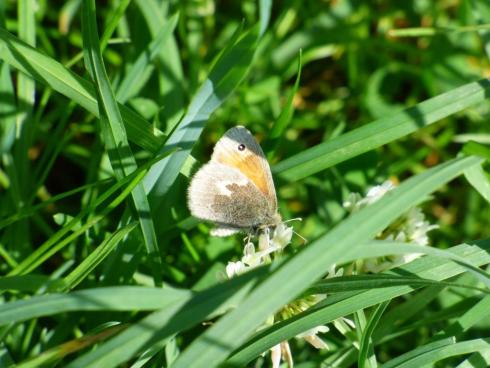
Small Heath

A bit of unexpected invertebrate interest occurred one morning when I was coming back from the ternery. I spotted a pair of beetles mating on the sandy path through the dunes south of the barrier fence – thankfully before my boot came down on top of them, though it was a close-run thing. Disaster averted, I spent the next few minutes like a young Gerald Durrell on hands and knees with my nose in the grass, fascinated by the lives of these unfamiliar insects. After mating, the female carefully dug herself a burrow in the soft sand and disappeared from view, leaving only a tiny ‘molehill’ of sand grains as evidence of her presence. The male, meanwhile, milled around above-ground for a few moments, then flew off in that rather drunken fashion peculiar to beetles. So what were they, and what was their story?

Beetles – love me do

Initially I had thought that these were Garden Chafer beetles (Phyllopertha horticola), a widespread but probably under-recorded species in the UK. Sharp-eyed volunteer Richard had recently reported this species elsewhere on the Reserve, backed up with an excellent description. However, when I later looked back at the photos I had taken, it appeared that ‘my’ beetles looked a better fit for the Dune Chafer (Anomala dubia), a very scarce species in Scotland, but one that has previously been recorded several times on the east Aberdeenshire coast. At the time of writing I am in the process of seeking a second opinion from a proper entomologist, not a jack-of-all-trades like me!

Dune Chafer… I think!

Further north on the coastal heath, we’ve reached that time of the year when the Crowberry fruits start to ripen. Consequently they’re on the menu for everything from Crows to Foxes to Starlings and so on, and for the next few months we’ll all be playing that timelessly entertaining game of ‘whose purple poo is this?’ – a real family favourite.

Crowberry fruits
Who’s been eating Crowberries then?

In botanical news, Foxgloves are a prominent presence just now, particularly along parts of the Dune Trail and in the margins around Sand Loch. Their tall and stately stems of purple or white flowers are instantly recognisable, and are also popular with Forvie’s Bumblebees. To that end, each individual flower is bedecked with a series of black-and-white psychedelic-looking dots, and these form a ‘runway’ to guide visiting insects to the nectar and pollen contained within.

Foxgloves
Psychedelic dots

We also spotted one of Forvie’s more cryptic floral specialities this week. Frog Orchids are much scarcer and less showy than the Northern Marsh Orchids that are so familiar to our visitors and local residents. These are found in only a couple of spots on the Reserve, and even if you know where to look, they still take a bit of searching out. Being largely yellowish-green, or at best slightly coppery-coloured, they tend to blend in well with their surroundings, unlike the bold purple flowers of their Northern Marsh cousins. The individual flowers of the Frog Orchid, with their forked and elongated lower petals, are said to each resemble a tiny frog, but this does take a bit of a leap of the imagination.

Frog Orchid – see the resemblance?
Nope, me neither.

While writing this week’s missives, I have been reminded of the advancing year by the noisy presence outside my window of several fledged Blue and Great Tits. Both of these common and familiar species tend to raise just one brood of young per year (by contrast, other small birds such as Blackbirds and Robins will raise several broods each summer). For the Blue and Great Tit parents, therefore, their work is nearly done – despite the fact we’re only halfway through the year.

Blue Tit babies sharing lunch

For the remainder of us though, there remains much work to be done as we move into the second half of 2024. No rest for the wicked!

Old lags and new faces

At the best of times, life here at Forvie is an odd mix of continuity and change, a blend of the old and the new. But never is this more vividly apparent than in high summer, when new arrivals and old stagers rub shoulders with one another, each playing their part in an endless and timeless cycle of life.

Late June at the ternery is a case in point. Here we now find ourselves in the critical four-week period of the year, the make-or-break stage of the bird breeding season. Amongst all the noise and chaos of the gull and tern colonies, many thousands of new faces are making their respective starts in the world. All of our tern and gull species have now successfully hatched chicks, and this next crucial month or so will determine how many of these fragile bundles of fluff will survive to fledging, and thence adulthood.

Sandwich Terns at their colony
One of our new arrivals

The ternery itself, of course, is nothing new. There are detailed records of terns breeding on this site going back to the late 1950s, courtesy of the pioneering and outstandingly dedicated local ornithologist Alistair (A.J.M.) Smith. Alistair devised a method of marking Forvie’s Sandwich Terns with coloured leg-rings, allowing them to be identified (and thus aged) in the field, without having to actually recapture the bird. Alistair has long since retired from front-line duties in protecting and monitoring Forvie’s terns, and though he retains a keen interest, it’s been many years since he ringed any birds himself. It was remarkable, therefore, that one of Alistair’s birds, bearing his own home-made rings, was resighted in the colony just this week.

Who’s this old-timer?

The indefatigable Raymond Duncan from Grampian Ringing Group tells me that this particular Sandwich Tern, bearing a colour combination of green over red, was ringed as a fledgling in the year 2000. At 24 years old, it’s just a year younger than seasonal warden Joe (and, hilariously, it’s two years older than I was when I started working here). But despite being one of the old lags in Sandwich Tern society, it’s looking pretty good on it – particularly when you consider that this individual will have made the long trip to South Africa and back every year for over two decades.

Wearing it well

Of course, only a relatively small proportion of Sandwich Terns are ringed, so there might well be even older birds knocking around in the population that we simply don’t know about. Unfortunately, there’s no way of telling from their appearance. A Sandwich Tern at three years old looks, to our eyes at least, just the same as one at 30.

There is, however, a bit of individual variation in moult timing, though this doesn’t seem to be age-related. The most obvious manifestation of moult in Sandwich Terns is when they start to lose their summer-plumage black cap, and start to acquire their winter-plumage white forehead and crown. This can start to happen in early June in some individuals, and I’m fond of likening it to a harassed parent turning prematurely grey – it’s the stress of all the long hours, the demanding kids and the noisy neighbours. Either way, it’s a sure sign of the year advancing.

A prematurely grey parent

Our other tern species are also progressing well at the time of writing (touch wood), with the Arctic and Common Tern nest census having produced 780 clutches of eggs – surprisingly, after last year’s avian ‘flu devastation, this represents a modest increase upon last year’s population.

Now is the critical point of our Arctic Terns’ season

These too are at a critical juncture in their season. A widespread hatch is underway, and many nests now contain small chicks (known in the trade, at least here, as ‘fluffits’). If they get four weeks of good weather, a reliable food supply and a bit of luck in avoiding predation, they will survive to fledge. But a prolonged downpour, a breach of the electric fence by a predator, or a downturn in fish stocks may each spell disaster.

Mum, dad and youngster
A day-old ‘fluffit’

Like their Sandwich cousins, Arctic Terns can also be remarkably long-lived, and in 2018 we recovered a ring from a freshly-dead one that turned out to be 32 years old. The proportion of Arctic Terns that carry rings is much smaller than in Sandwich Terns, so we know much less about their population demographics. But it’s another fair bet that there’ll be a good few old-timers among Forvie’s breeding population.

An ageless Arctic Tern

Forvie’s Black-headed Gulls, by contrast, are quite a bit further through their season. The first fledglings were noted on the wing on Tuesday – just three of them, but a start nonetheless. Seeing the first one take flight is always a brilliant moment, not least because it’s a relief that whatever happens now, our colony has at least produced something this year.

Black-headed Gull fledgling – hopefully the first of many

Moving away from the ternery for a moment, late June seems an opportune time to sort out the differences between Forvie’s two red-and-black day-flying moths, both of which are on the wing just now. These, in fact, neatly fit with this week’s theme. One species – the Six-spot Burnet – is an old-timer, a long-term resident of Forvie, whereas the other – the Cinnabar – is a relative newbie, having only been first recorded here in 2009. The following two photos illustrate the differences between the two, both in terms of structure and markings.

Six-spot Burnet moth – note the red spots
Cinnabar – note the red bar

There are new faces around in the world of mammals too. Rabbits have become a bit of a collector’s item on the Reserve in recent times, with two diseases to contend with these days – the old foe of myxomatosis, and the new threat of viral haemorrhagic disease. Despite this, small populations are hanging on in certain parts of the Reserve, such as along the estuary-side footpath and at the ternery. June is peak breeding season for Rabbits too, and now and again we see litters of young – but these are a much rarer sight now than they used to be.

Rabbit babies

Midsummer is also birthing-time for our Roe Deer. These tend to be discreet in their habits, and their vulnerable offspring are usually kept hidden away in the long grass, safe (hopefully) from the watching eyes of potential predators. Now I know I’m about to sound like a broken vinyl record by repeating the ‘dogs on leads’ message here, but it’s still undoubtedly the single most widely-ignored request that we make of visitors to the Reserve. And as I’m always saying, it’s a request we make for good reason, with the Roe Deer being just one of the species on the receiving end from dogs running free. So please spare a thought for the wildlife when you bring your dog onto the Reserve – and as always, we’re extremely grateful to those who do.

Roe Deer doe and her new arrival

As a final item to fit with the ‘old and new’ theme this week, we recently encountered a couple of colour-ringed Stonechats on the Reserve. Like the Sandwich Terns we described earlier on, these Stonechats had each been fitted with coloured leg-rings as part of a study into the species’ migratory movements. One of them had been ringed at the ternery earlier in the year, and had since moved all of a mile from his ringing site. He was now residing at Rockend with his partner and at least two fledglings.

Colour-ringed Stonechat

The second bird had been ringed on the Reserve last autumn as a juvenile, i.e. hatched earlier that same year. Interestingly, when we saw him at the north-eastern corner of the Reserve last week, he already had a partner and at least two fledged young of his own – despite being less than a year old himself. A newbie, and yet already an old hand, now playing his own part in the endless, timeless cycle of life.

Small is beautiful

Midsummer at Forvie – even in dismally cold and wet years such as this one – is the time when our wild flowers are at their zenith. The few weeks from early June to late July each year see an explosion of colours throughout the Reserve, from the footpaths and loch-sides of the Heath Trail in the north, to the plant-rich dune-slacks in the south. For the botanically-minded visitor, this is a great time to get out and do some exploring.

Mind and bring your knee pads though. Owing to the harsh climate and the nutrient-poor, free-draining soil, life for plants here is not easy. As a consequence, most of our more interesting plants are really tiny – but as this week’s title says, small can be beautiful.

A carpet of flowers

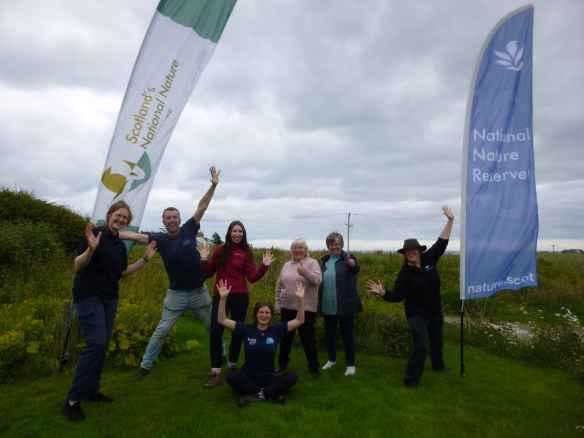
On Friday we welcomed onto the Reserve a group of colleagues from headquarters, and their guided tour of South Forvie had elements of an impromptu botanical field trip. Our route around the Dune Trail took in some of the wildflower-rich dune slacks along the line of the barrier fence, which runs west to east from the estuary to the North Sea. These dune slacks are home to some of Forvie’s rarer plants, as well as a colourful array of its commoner ones, providing us with plenty to enthuse about to our visitors.

An impromptu botanical field course
Northern Marsh Orchids out in force

In mid-June, much of the background colour is provided by Bird’s-foot Trefoil, whose yellow-and-orange flowers form a dense, soft, sweetly-scented carpet. This is one of the quintessential plants of the duneland environment, and is also the larval foodplant for the Six-spot Burnet moth – one of the quintessential insects of this landscape. Despite the cool and capricious weather, these moths have begun to emerge in good numbers in this past week, and it’s getting to the point now that you’d be hard-pressed not to notice them on your walk around the Dune Trail.

Bird’s-foot Trefoil
Six-spot Burnet on Northern Marsh Orchid

In other places, the yellows of the Bird’s-foot Trefoil are countered by the blues and whites of Wild Pansies, or the tiny, bright-red sprays of the diminutive Sheep’s Sorrel. These are each typical plants of dune grassland, and like so many others, they look their best during this fleeting few weeks of high summer.

Wild Pansies and Sheep’s Sorrel

Some of Forvie’s rarer and more unusual plants are similarly pint-sized. Purple Milk-vetch is known to grow in just one spot on the entire Reserve – halfway along the estuary-side track between the ‘Eider bench’ and the barrier fence – and unless you’re specifically looking for it, you’d likely just walk right past it. Tiny and low-growing, its flowers are nevertheless a treat to behold: sumptuous royal purple with little white insets. One of life’s pleasures.

Purple Milk-vetch – a wee cracker

Less brightly-coloured, but no less distinctive, are the strange yellow-green protuberances of the Small Adder’s-tongue Ferns that can be found in the damper dune-slacks. This is one of Forvie’s rarities that seems to be doing rather well just now, with several new large populations of the plant discovered in recent years. The continued wetting-up of certain areas of the Reserve, as a result of high rainfall during recent years, appears to be benefitting this species – every cloud and all that.

Small Adder’s-tongue Ferns
The distinctive, finger-like, spore-bearing spike

Sadly, it’s not all good news though. Another of our rare and unusual plants, the enigmatic Oysterplant, has gradually been getting scarcer at Forvie. This species is adapted for life at the top of the littoral zone; that is to say the seashore above the high-water mark. Here it grows among the shingle, and and loose rock, able to survive the harsh and salty environment where most other plants would perish.

Oysterplant – rare and beautiful
Shingle-beach specialist

Twenty or so years ago, Oysterplant could be found on several of the rocky and shingly beaches beneath the cliffs between Collieston and Hackley Bay. In recent seasons, though, it has become confined to its last remaining stronghold next to the Poor Man, a prominent rocky stack just south of Collieston village. However, an inspection of this area in early June failed to produce any sight or sign of the plants, and it’s feared that the massive high tides that we experienced during the winter have washed out the remaining population. A sad loss for the Reserve, and an illustration of the fragility of some of our wildlife in the face of changing climatic and sea conditions.

The now-barren beach by the Poor Man

The Poor Man takes its name from its distinctive appearance. From certain angles, it supposedly resembles a hunch-backed old man carrying a sack upon his back, perhaps gathering driftwood for the fire from the shore. It’s a bit like the ‘man in the moon’, in that some folk can see it, and others just can’t. Judge for yourself!

Come on, use your imagination…

Cutting our losses from the failure to find any Oysterplant, we at least got the chance to explore the rocky shore around the Poor Man. Here, as in so many places along our coast, we were amused to find Thrift growing in apparently-impossible situations.

Thrift, doing what Thrift does best

A poke around in the rockpools is always enjoyable, and here, once again, is a world in miniature. Sadly we didn’t have enough time to really make the best of it, but a quick search soon found some Beadlet Anemones stuck fast onto the tidal rocks. Out of the water, these look like nothing so much as an amorphous blob of strawberry jam, but if you find one submerged in a rockpool, their true form is revealed – tentacles and all!

Beadlet Anemones – high and dry…
…and in the rockpools.

Just occasionally, the littoral zone produces something really special. This happened to volunteer Elaine once at Rockend, when she happened upon this beautiful Octopus in one of the tidal pools where the beach meets the rocky shore. To say I was envious of the sighting is a preposterous understatement.

Octopus in a tidal pool – wow!

Meanwhile, a walk along the coast path in the week turned up another slightly unusual bit of marine wildlife. An odd shape among the heather and grass caught my eye, and on closer inspection it turned out to be a rare extra-limital sighting of a species not usually found in this sort of habitat.

Huh?
How did you get here?!

Rather than being an attempt by this species – probably a Flounder, by the way – to colonise new ground, we suspect that this unfortunate ‘sole’ (sorry) ended up in this strange ‘plaice’ (sorry) after being captured by a gull, who then found it too difficult to swallow, and eventually gave up and left it. Eyes bigger than belly, I reckon.

This seems to me to be a case-in-point that sometimes – even when it comes to selecting your supper – small is beautiful.

On the cliff edge

The first week of June at Forvie is informally known to the Reserve staff as Seabird Week. This time each year, we take to the cliffs in order to census the seabirds that nest there, as part of a national monitoring programme which dates back to the 1980s. The job itself is undeniably enjoyable, and in terms of methods and setting, it’s a marked contrast to our ongoing work at the ternery – which incidentally feeds into the same national database of seabird knowledge.

Data, of course, is the lifeblood of science, and science is what underpins our efforts to conserve what’s left of the natural world. Consequently, Forvie’s seabird colonies – despite not being of the same scale or grandeur of the Fowlsheughs, Shiants and St Kildas of this world – have an important role to play in providing long-term data for the purposes of seabird conservation.

Working on the edge of the world

The photo below is a fairly typical example of what we’re faced with. Our cliff-nesting seabird census takes place from land – no messing about in boats for us, unfortunately – and the aim is to establish the breeding population of each species, each year. Sounds fairly straightforward, right enough.

A typical seabird stack at Forvie

The first part of the equation is to identify the species in question, which is easy enough for those of us with a good deal of seabird experience. The second, and by far the more awkward part, is to decide whether that particular bird, or pair of birds, is actually tending to an active nest. For most of Forvie’s seabirds, the ‘count unit’ for the purposes of this survey is the Apparently Occupied Nest (or the AON, for all you acronymophiles out there) – the key word being Apparently.

The standard survey methodology defines an AON as ‘a well-constructed nest, capable of holding eggs or young, with one or more adults in attendance’, or words to that effect. You don’t need to actually see the eggs or young, which is a good job as most of the parent birds tend to sit tight. But it therefore requires a judgement-call on the part of the observer as to whether that Herring Gull/Kittiwake/Shag is a parent bird sitting on an actual active nest, or just a non-breeder having a rest on an old nest or pile of dead grass.

Apparently-occupied Kittiwake nests?

Each species has its own niche on the cliffs, and nesting habits to match. Kittiwakes, for instance, occupy the most precarious ledges, and make snug cup-shaped nests from vegetation, glued onto the almost-vertical rock with a liberal application of home-made adhesive (which is white in colour, and smells strongly of second-hand fish). ‘Malodorous but effective’ is probably a fair description of this method of nest construction.

Kittiwakes in their impossible-looking nests

Larger gulls, by contrast, throw together a rough bowl of dead grasses and other plant material on a broader ledge or outcrop. As a breeding bird, Herring Gulls have declined at Forvie by some 99% since these annual surveys began in the mid-1980s, and this year we found just 19 nests between Collieston and Rockend. So when you read the inevitable newspaper articles about the ‘gull menace’, and how these ‘vermin’ ought to be culled, take it with a massive pinch of salt. But as we know, balance and perspective don’t sell newspapers quite as effectively as sensationalism and outrage.

Herring Gull with her chicks

The largest species of gull on Forvie’s cliffs, and for that matter the entire world, is the Great Black-backed Gull. These build their scruffy nests of vegetation on the very tops of the cliff stacks, where they have the best view of all their neighbours (and their potential next meal – same thing). Despite their fearsome reputation as formidable predators of other seabirds (to the extent that in a previous workplace, we referred to them as ‘GBH Gulls’, as opposed to the usual abbreviation of GBB), these too have declined from six or seven pairs in the recent past to just the one pair this year.

GBH Gulls at the nest

Fulmars have also endured a rise-and-fall scenario in recent years. Their population at Forvie grew to several hundred nesting pairs in the early 2000s, yet this year we recorded just 41 apparently-occupied nest sites. A change in fishing policy, with fewer and larger vessels operating, and less in the way of discards available to the birds, may have had an impact. But for now, these characterful birds – our nearest relations to the albatrosses of the southern hemisphere – are just about hanging in there.

Fulmars – an old married couple

Other seabird populations in the North Sea have suffered greatly over the past twelve months, firstly at the hands of avian influenza, and latterly from the effects of a particularly bad storm season last autumn and winter. One of our contacts in the bird-ringing business reckons that Shags have declined by a whopping 85% in our region since last summer. With this in mind, we considered ourselves lucky that from three breeding pairs last year, we still retained one pair this year; we fully expected to find none at all.

Shag – one of the survivors

Auks, too, have had a hard time of it over the last couple of years for the same reasons. our small populations of Guillemots and Razorbills had also taken a substantial hit compared with last season, but are both gamely hanging on. Forvie’s cliffs would certainly be a good bit poorer if we lost our complement of these comical and endearing birds, bobbing and bowing on the ledges like little wine-waiters, each smartly turned out in starched white shirt and black tailcoat.

Razorbill (left) and Guillemots

The long hike along the cliffs involved a substantial amount of ‘off-piste’ walking, in order to get a view of all the rock faces. During the course of the day we also encountered a nice selection of other interesting wildlife, not least when Joe happened upon this perfect little Meadow Pipit nest among the long grass. Although Meadow Pipits are common enough throughout the Reserve, it’s not every day – or indeed every year – that you find a nest, so well are they hidden. This is why we ask folk to keep their dogs under control and on the footpaths – there are nesting birds out there, even if most of the time you can’t see them!

A picture-perfect pipit nest
Meadow Pipit – expectant parent

A little further along the cliff, we found this explosion of feathers. These were identifiable as belonging to a Feral Pigeon, the gone-wild former domestic doves that nest commonly among the rocky crags. It’s highly likely that this was the work of a Peregrine. These iconic falcons don’t nest at Forvie, but frequently visit the Reserve from territories further north along the coast – pigeons beware.

Peregrine 1, Pigeon 0.

Offshore, further interest was provided by a small pod of Bottlenose Dolphins. This was the third occasion in the past month or so that we’ve seen these lively and exuberant beasts off Forvie’s cliffs, and an encounter with them is always guaranteed to raise a smile. Cetaceans such as these, and others such as Minke Whales, are probably more common here than we realise – but we simply don’t get to spend enough time staring out to sea!

Flipper and family

We were also treated to the sight of at least four Arctic Skuas heading north up the coast, pausing en-route to harry the local terns and Kittiwakes for their catch of fish. These swashbuckling pirates of the high seas are one of the most agile fliers in the bird world, combining the muscle and power of a falcon with the elegance and effortlessness of a tern. Substance and style – a rare combination!

Arctic Skua northbound

Luckily for us, the forecast rain didn’t materialise until the very end of the census; wet conditions make the survey work awkward, and the grassy clifftops dangerously slippery. But by the time the heavens opened, our work was safely done.

Rain on the horizon

When you work on Reserves, you can’t afford to be shy of the weather, and I think most of us actually get some sort of masochistic pleasure from being out in the worst conditions going. Judge for yourself from the following photos anyway.

Three drookit loons
It really was that bad.

So after completing the census, and having received a comprehensive drowning, we had a mile and a half’s walk to get back to the office, all of us soaked to the skiddies. But after a great day on the cliffs, there was no dampening of anybody’s spirits. Given the choice between this or driving a desk for a living, there’s no doubt that we’d all choose the soaking every time.

Pour me a ‘Jar

By the time this article goes to press, the month of May will be over and done, having gone by in a blur. Looking back over the eighteen Mays that I have worked here on the Reserve, I can’t think of any that have been busier, more exciting or more exhausting than this one. In any given year, May is usually a fast-moving and action-packed month at Forvie, but this year it’s been exceptional from start to finish. The sightings board in the visitor centre stands testament to this, being possessed of a distinct ‘read-’em-and-weep’ sort of quality just now.

That’ll have been a busy second half of May then.

For the second week running, there was a great deal of excitement in our area concerning drift-migrants. In fact, this started off before the working week had even begun. Strolling up the garden to open up our polytunnel before heading onto the Reserve on Monday morning, I was astonished to flush up a Nightjar which had apparently been sitting on the garden fence. I’m not sure which of us got the biggest shock.

Nightjar in flight

Having been rudely (and unintentionally on my part) awakened from its slumbers, the ‘Jar headed off towards Sand Loch, where it promptly sat down in the middle of the road which forms the north-eastern boundary of the Reserve. Its raptor-like appearance in flight meant that it garnered a lot of unwanted attention from the local Starlings, Jackdaws, House Martins and others, none of whom had probably ever seen one of these before. This entourage kicked up an almighty racket, thereby telegraphing its whereabouts to all and sundry – including reserve manager Catriona, who hurried to the scene in order to catch up with one of her most sought-after species in the entire natural world.

Nightjar on the road at Sand Loch(!)

The continued attentions of Jackdaws and Starlings soon served to push the poor old Nightjar off the road (in all honesty probably for the better), and it swiftly returned to the same stretch of garden fence where it had started out. This gave us, and a handful of other lucky local observers, the once-in-a-lifetime chance to see a Nightjar at close quarters and in full daylight – a chance to appreciate its intricate plumage and bizarre appearance.

This is one of the true weirdos of the bird world. Usually strictly nocturnal (hence the strangely large eyes, and the sleeping in the daytime), the Nightjar feeds on large flying insects like moths, which it catches in flight by ‘trawling’ with its huge mouth open. Its colossal gape is further enhanced by a surrounding array of bristles, which help to funnel insects into the yawning chasm of its mouth. The Nightjar’s voice is no less weird: the male’s song (given at night, of course) is an unearthly ventriloquial noise known as ‘churring’, which sounds more mechanical than natural. By day it relies on its exceptional camouflage to avoid detection. This works supremely well in a natural environment such as heathland or woodland floor, but isn’t quite so effective on a post-and-wire fence.

Having a snooze on the garden fence

Regular readers of these missives will know that I am very keen on my ‘garden list’, and the itinerant Nightjar constituted the 175th bird species we’ve recorded here (don’t get me started on the moths or the plants though, or we’ll be here forever). I love ‘garden listing’ for a number of reasons; I am a big advocate of letting the wildlife come to you, though I suppose this is easy when you’ve got one of Scotland’s premier National Nature Reserves literally just over the back fence. But it’s become almost a citizen-science experiment to see how many different species drop in by one small back yard over the course of time.

A substantial part of making a garden good for wildlife is the provision of something approaching ‘natural’ habitat. This we did when we built a small pond and introduced some native water-plants, which have since developed into a magnificent three square metres (count ’em) of something approaching fen meadow.

Three square yards of ‘fen meadow’

The old line ‘build it and they will come’ is never truer than in the wildlife-gardening sense. Unbelievably, our three square metres of fen on Thursday lunchtime played host to a Marsh Warbler, yet another rare migrant to our shores, that for a short while looked completely at home in our tiny patch of contrived wetland. Like the Nightjar, this elicited considerable punching of the air after the event – species no.176!

Marsh Warbler… you couldn’t make this stuff up.

The continued arrival of drift-migrants extended onto the wider Reserve, with at least two more Red-backed Shrikes passing through since our last update. A superb male, resplendent in his full spring finery, spent a morning outside the Forvie Centre, where once again the local insect populations took a hammering.

Another cracking Red-backed Shrike

At one point he came face-to-face with one of the Yellowhammers who are nesting in the hedge nearby. Small birds such as buntings, finches and pipits tend to ‘mob’ shrikes, recognising them as potential predators. Although a Yellowhammer is barely any smaller than a Red-backed Shrike, it is a potential meal-in-waiting, so you had to admire this particular Yellowhammer’s courage. Catriona captured a nice photo of the two of them together, which would actually make for a good caption competition. Please leave your entries in the ‘comments’ section – first prize will be a day out birding with me on the Reserve; second prize will be two days.

Shrike and Yellowhammer exchanging niceties

In other news this week, we were pleased to get the Heath Trail wildflower information-boxes back out on site. These will remain in-situ for the rest of the summer while Forvie’s plants are looking their best. It’s a bit early yet for some of the species in question to be in flower, which made our lives awkward when trying to find examples of each species with which to match the boxes! Others, however, are now looking really good, with the Northern Marsh Orchids in particular putting on a really good display just now.

One of our popular ‘wildflower boxes’
Northern Marsh Orchid

Insects at large on the heath this week, spotted while we were distributing the wildflower boxes, included the lovely yellow-and-black-chequered caterpillars of the Six-spot Burnet moth, while now and again the amusingly tufty Dark Tussock moth caterpillar could also be found.

Six-spot Burnet caterpillar
Caterpillar of Dark Tussock moth

Other moths are more well-advanced through their life-cycle by this stage of the year, and can be seen on the wing as adults. As well as the red-and-black Cinnabar, which is easily recognised and frequently seen around the trails, you may also spot the more cryptic yet subtly-beautiful Common Heath.

Common Heath moth – a day-flying species

Lastly, a bit of an update from the ternery. In mid-May we carried out the Black-headed Gull nest census, finding 1,831 nests containing eggs. This is about 25% down on last year’s total, which isn’t necessarily surprising given the impacts of avian ‘flu (and besides that, 2023’s population was an all-time site record in any case, so probably isn’t the most realistic baseline). Last week it was the turn of our Sandwich Terns, and again we expected to record a significant decline from last year’s total, with the species having been decimated by the ‘flu throughout Europe.

Much to our surprise, however, the census revealed a total of 911 nests – actually a modest increase (of just eight nests) since last year. This goes to prove, for the umpteenth time, that it’s almost impossible to gauge what’s going on in the colony from outside its protective electric fence; it’s not till you actually go in and get your hands (and hats, and overalls) dirty that you can be sure of what’s happening in there.

Part of the Sandwich Tern colony during the census

The census also produced the first Sandwich Tern chicks of the year. Even when they’ve dried out after hatching, these retain a ‘wet-combed’ appearance, with spiky-looking down when compared with the adorably-fluffy Black-headed Gulls alongside them.

A freshly-hatched Sandwich Tern chick

By way of comparison, Catriona photographed this nest which contained a Sandwich Tern egg, a Sandwich Tern chick and a stowaway Black-headed Gull chick. This appears somewhat unusual, but the chicks of both species are quite mobile, and are apt to wander around and mingle with one another. And when danger looms, such as a Reserve warden towering overhead (though these aren’t nearly as scary as they look), it doesn’t matter who you snuggle up with, as long as you’re out of harm’s way!

Snuggle time

So May’s done and dusted, and more’s the pity, for what a May it’s been. Onwards then into June, which is traditionally another manic month here on the Reserve. There’ll doubtless be plenty to report. Meantime, though, I’m off for a couple of ‘jars’ – cheers!

Eastern promise

Here at Forvie, perched as we are on Scotland’s east coast, we occupy the frontier between the British Isles and the continent of Europe. The proximity of the continent, and the salty moat of the North Sea that divides us from it, have a profound influence upon both our climate and our wildlife.

This continental influence gives the east coast a generally dry climate (don’t laugh), with cold winters and dry summers, compared with the milder and wetter maritime climate experienced by Scotland’s west coast. Admittedly this seems hard to believe after the washout summer of 2023, and the largely mild winter that followed. But while spring was late to arrive this year, mid-May finally put together a series of fine days that actually made us believe in this phenomenon.

A flawless May day at Forvie

The fine weather corresponded with a period of easterly and south-easterly airflow from continental Europe. This provided ideal conditions for an early-season immigration of insects to our shores. After the first couple of fine days in a row, we started to notice Silver Y moths everywhere, bombing around the Reserve by day and nectaring at various flowers. One or two also found their way into the moth trap, allowing for a close-up view of their intricate markings, including that lovely silvery squiggle on each forewing. This is a moth whose common name makes perfect sense.

Silver Y – note the silver Y

When moth-trapping in May, our ‘stock’ moth – i.e. the species that makes up the bulk of the numbers – is the Hebrew Character. Like the Silver Y, its common name derives from the distinctive markings on the forewings. In theory, this is the only species of moth on the wing in May to show such a marking, rendering identification very straightforward (this is seldom the case with moths at the best of times). However, the south-easterly airflow threw an entomological spanner in the works – have a look at the photo below.

Sure enough, the moth on the left is a ‘standard’ Hebrew Character – but try a wee game of ‘spot the difference’ with the one on the right…

A right pair of Characters

After consulting moth oracle Helen Rowe (of Aberdeenshire Council Ranger Service fame), we established that the right-hand moth was in fact a Setaceous Hebrew Character – a bigger-and-grander name, as befits a slightly bigger-and-grander moth than the ‘standard’ one. But the rather preposterous name isn’t the main point of interest here; the curious thing is that this species shouldn’t actually be on the wing until midsummer. Helen’s theory was that this too was an immigrant – likely from somewhere far to the south and east of us, where the species emerges much earlier in the year than it does in Scotland.

Mystery solved then. And what an amazing migratory feat for so small and delicate a creature.

Setaceous Hebrew Character

We also noted the presence of Marmalade Hoverflies along the coastal strip in the week. Though these occur commonly in Scotland, their numbers are significantly bolstered in some years by mass immigration from the Continent. Such influxes of Marmalade Hoverflies are usually noted here in late summer, often in conjunction with arrivals of Painted Lady butterflies, and the two species share the same life-strategy: advancing northwards through Europe each summer over the course of several generations, with the final generation then making a southward journey in autumn to complete the cycle. To see arrivals this early in the year is more unusual, but it’s likely that the same south-easterly winds that assisted the moths on their North Sea crossing also gave the hoverflies a helping hand.

Marmalade Hoverfly

Around mid-week, the wind changed to a straight easterly and thence north-easterly, accompanied by a deterioration in the weather. Initially, the clear skies and warm temperatures were replaced by the dreaded haar, but by Wednesday afternoon a belt of heavy rain had set in. This meant a switch in wildlife interest from immigrant insects to migrating birds.

Haar haar, me hearties

In spring, birds moving from Africa and southern Europe towards Scandinavia can be subject to a mechanism known as drift-migration. This is when a crosswind ‘drifts’ them off their usual course; if the crosswind is blowing from an easterly direction, birds may be ‘drifted’ across the North Sea onto the eastern seaboard of the British Isles. A promising-looking set of weather charts can thus prompt excitable discussion among students of bird migration, and last week was a case in point. You see, the rain is the key ingredient here.

Under clear skies, drift migrants pass over our coast at great height, eventually settling somewhere inland and likely going undetected. But throw in a bit of rain and bad visibility, and these travellers are forced to make landfall on the first solid ground they encounter after crossing the North Sea. This is what gets the juices flowing for the east-coast observer: the chance to encounter species not often seen on our shores.

Wednesday’s rain didn’t take long at all to do its stuff, and by supper-time we had already clocked an Icterine Warbler on the north-eastern boundary of the Reserve – a rare species that we’ve only recorded here on a handful of previous occasions. Game on!

Icterine Warbler – photo (c) Ron Macdonald

I was out of bed ridiculously early on the Thursday morning, slightly delirious from a combination of lack of sleep and wild optimism about all the fabulous rarities I might see. As it turned out, the Reserve proved remarkably quiet, but it was the unlikely setting of the back road between Collieston and Whinnyfold, just to the north of Forvie, that provided the pot of gold.

Who’s that lurking in the willows?

Here, working the fence-lines, was one of the finest sights in Scottish ornithology. A spring male Red-backed Shrike, a picture of European flair and extravagance, brought to our doorstep by a favourable wind and a drop of rain at the right time. Surely one of the handsomest of all birds, dressed in fine pastel shades, a flashing black-and-white tail, a dashing bandit-mask, and an attitude to match.

A splendid male Red-backed Shrike

The small size of a shrike – somewhere between a warbler and a thrush – belies its true identity as a predator. Red-backed Shrikes can take prey items as diverse as reptiles, amphibians and even small songbirds, but their real stock-in-trade is large insects. The abundant St Mark’s Fly appeared to be the lunch of choice on this particular Thursday; the rain had served to make them sluggish and easy to capture, and we saw a number of them disappear down the hatch.

St Mark’s Fly – on the lunch menu

Red-backed Shrikes are a former breeding species in the UK, but went extinct as a breeder during the late 20th Century. This was likely due to a number of factors, with the decline in large insect populations probably at the top of the list (but dishonourable mentions must also go to climate change, agricultural intensification, and illegal egg-collecting, which did for the last survivors in East Anglia in the 1980s). This past week has seen a notable influx of Red-backed Shrikes into the UK – all drift-migrants assisted by the easterly winds, of course – but such events raise the hopes that one day these magnificent little birds may once again raise their young on our shores.

A right proper stonker

In your author’s humble opinion, the only drift-migrant to beat a male Red-backed Shrike for aesthetics is the male Bluethroat. So for good measure, the same stretch of local back road also produced one of these. For the keen naturalist, some days just turn out lucky, and last Thursday turned out one of the luckiest days I’ve experienced in some years.

Bluethroat!

This is another species that really ought to be a UK breeder. Problem is, their favoured habitat is upland willow scrub, on the tree-line between the forest and montane zones. This is a habitat woefully lacking in Scotland, due to centuries of over-grazing by sheep and deer. It’s a brutally simple equation: no trees in the uplands = no Bluethroats. Sadly, therefore, the only chance the Scottish naturalist has to catch up with one of these stunning birds is to encounter a coastal drift-migrant such as this one – and take it from me, these opportunities are few and far between!

Look at the colours on that!

There may be some cause for optimism though. Through the efforts of landscape-scale conservation projects such as Cairngorms Connect, and the pioneering work of NatureScot colleagues at National Nature Reserves such as Creag Meagaidh and Beinn Eighe, significant areas of the Scottish uplands are on the road to recovery. Meanwhile, drift-migration, such that we’ve seen in the past week, can provide a source of birds from the apparently-healthy Scandinavian population to colonise – or indeed re-colonise – the rejuvenated upland forests. This fabulous little bird is a jewel in the crown of our uplands, just waiting to be restored to its rightful place. I very much hope that I live to see that day.

A denizen of the restored Scottish uplands?

I’ll say no more for now, but instead will leave you with a short clip of ‘our’ Bluethroat indulging in a bit of singing-practice, set against a backdrop of Skylark song. Surely the voice of optimism itself. Enjoy, and be hopeful!