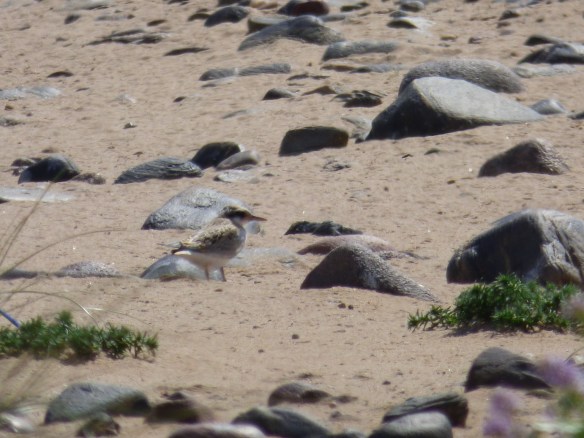
A midsummer mash-up

When coming up with these weekly missives, the most difficult pieces to write are those where a clear theme isn’t easily forthcoming. On these occasions, you can end up pinging all over the place from one subject to the next, and I’m afraid to say that this week’s blog is one of those. Perhaps it’s due to the season: what with the workload and the relentless daylight, midsummer is when exhaustion and delirium can start to set in. After nineteen summers here, you’d think I ought to be used to it by now…

Anyway, midsummer it is then. As the first week of July comes to a close, so Forvie’s appearance has begun to change once again, with the two out of three heather species now bursting into flower. While the Ling won’t really start flowering for another month or so, the rich purple of Bell Heather and powder-pink of Cross-leaved Heath can currently be seen throughout the Reserve. These favour dry and wet areas of the heath respectively; like all wild plants, each has its own specific niche in the world.

Bell Heather in bloom
Cross-leaved Heath

Growing among the blooming heathers alongside the Heath Trail were our first Heath Spotted Orchids of the year. I am proud beyond measure to have taken what I believe to be the world’s worst photograph of this attractive plant:

Heath Spotted Orchid (honest)

…so by way of compensation, here’s a photo of one from a previous season, so you can see what it’s actually supposed to look like.

Nice, huh?

The glut of wild flowers in bloom just now provides an all-you-can-eat buffet for Forvie’s bees, with the heathers proving especially popular. When all you’ve got at your disposal is a frankly rubbish camera-phone, capturing photos of busily-feeding bees isn’t an easy assignment. I just about managed to snap this ‘BLT’ (Bombus lucorum / terrestris = White-tailed or Buff-tailed Bumblebee) feeding on the flowers of Cross-leaved Heath.

BLT on the CLH

‘BLTs’ generally nest below ground, often taking over a disused rodent burrow or similar. However, their terrestrial habits leave them vulnerable to excavation by Badgers, who enjoy feasting on the larvae in the nest. It appears that this is what had happened to two bumblebee nests just outside the Forvie Centre this week, with a couple of roughly-dug holes in the lawn…

What’s happened here then?

…and a forlorn and confused gathering of worker bees, clearly wondering what had happened to their respective nests. Hard lines indeed, but that’s life: who’d be a bee?

“What’s happened to our beautiful house?”

A happier piece of insect news comprised the continued presence of Hummingbird Hawk-moths in the gardens of Collieston, adjoining the Reserve at its north-eastern boundary. Making good use of the ‘sports mode’ on her camera(!), Catriona managed to capture a remarkable series of photos of a moth nectaring at Knapweed flowers. Check out that incredible ‘tongue’!

Hummingbird Hawk-moth
Look at the proboscis on that!

Moths and butterflies are well-known to undertake some impressive migrations, along with other small invertebrates such as hoverflies. However, I was more surprised to note a ‘fall’ of tiny spiders had occurred along Forvie beach mid-week, with substantial numbers present along the barrier fence (where they seemed especially attracted to the brightly-coloured floats attached to the fence). I could only surmise that they were wind-dispersed – some spiders are known to deploy a silken ‘parachute’ by which they hitch a lift on the breeze – but I may be way off-piste with this theory. Either way, they made for an incongruous sight in the inter-tidal no-man’s-land of the beach.

On the coastal frontier: barrier fence
Where’ve you lot come from?

Being the first to admit how little I know about spiders, I would be very pleased to hear from any readers who might be able to identify these little beasts to species… and perhaps also shed some light on how they might have turned up in such an unlikely location!

The most unlikely of migrants!

Nearby at the ternery, things are fairly clearing out now, with a notable downturn in the numbers of Black-headed Gulls and Sandwich Terns present. Despite the smaller species still having a long way to go in their breeding season, overall the colony is now possessed of a distinct end-of-season feel.

Sandwich Terns clearing out

On Tuesday we were delighted to welcome Julian and Rosemary Smith from St John’s Pool nature reserve in Caithness, for a tour of Forvie and a talk about all things terns. St John’s Pool is a unique site in the far north of the Scottish mainland, featuring a freshwater lagoon with islands home to nesting terns and Black-headed Gulls, and with a direct link to Forvie too. At least some of the Sandwich Terns in the breeding colony at St John’s are known to have originated from our own colony here, having been identified by the Darvic rings (coloured plastic rings each embossed with a large and easily-legible three-letter code) on their legs.

Darvic ring ‘Red EBK’

This is a great example of how nature conservation isn’t confined by the boundaries of the Reserve. Whether on a publicly-owned site like Forvie, or a privately-run one like St John’s, the work done on-site can have an influence way beyond the boundaries of your own patch. It’s also a vivid illustration of the value of Darvic rings, which can be easily read in the field without having to recapture the birds in question.

The tern-ringing programme continues at Forvie each season, and a monumental effort this year has seen a record 1,024 Sandwich Tern chicks fitted with metal BTO rings, and 100 of these also fitted with Darvic rings. Credit for this huge power of work must go to the guys and girls of Grampian Ringing Group, led admirably and tirelessly by local loon Raymond Duncan, and to Danny and Joe who have supervised the vast majority of the ringing sessions at weekends and evenings. Who knows, maybe some of this year’s cohort of Sandwich Terns might turn up at St John’s in a few years’ time when they’re of breeding age themselves!

Darvic-ringed Sandwich Terns at Forvie: next stop St John’s?

One of this year’s Sandwich Tern chicks was extra special. For the third time in my tenure at Forvie, a pure white albino chick has fledged from the colony. This remarkable-looking individual was Darvic-ringed during the last session of the season, with Danny lucky enough to do the honours. Resembling a Fairy Tern from the tropics rather than a Sandwich Tern, it certainly stood out from the crowd! Should it survive to undertake its autumn migration, we’ll see whether it gets re-sighted en-route to southern Africa in due course.

Danny and Sannie

Finally, a piece of community-liaison work saw Catriona heading into Aberdeen to give an illustrated talk at the Greyhope Bay Centre. Based at Torry Battery, at the entrance to Aberdeen’s historic harbour, Greyhope Bay is a charity whose aim is to connect local communities with their coastal heritage – including wildlife of course! Forvie and Torry are within sight of one another, and share much in common in terms of coastal wildlife, so there was much to discuss. Catriona tells me there was a lively and feature-length Q&A session after her talk, which I always think is a good sign. Take it from me, there’s nothing more disheartening as a public speaker than being met with deafening silence at the end of your talk… no such issues at Greyhope though!

Catriona at Greyhope Bay

We’ll be returning to Greyhope Bay on Monday 21st July for Coastal Discovery Day, part of the Aberdeen Festival of the Sea 2025, giving us the opportunity to bring the Reserve to the people, so to speak. More than ever, nature conservation needs people and communities to buy into the cause, and we’ll take every opportunity going to spread the good word. Hope to see you there!

Sandwich smorgasbord

The last full week of June at Forvie proved to be something of a mixed bag, with some spells of hot sunshine sandwiched between bouts of biblical rain, and becalmed evenings following brashly breezy days. Consequently it was a week with a bit of something for everyone. Nice weather for barbecues / ducks / midgies / kite-flying (delete as appropriate): that’ll be midsummer in the North-east then!

In fact, the unsettled and unpredictable nature of the week’s weather only served to add to the frenetic feel to proceedings on the Reserve just now. As the Australian cricket commentator Bill Lawry used to say approximately every five minutes on air, “it’s all happening”.

A week of contrasts

Probably the biggest news of the week came from the ternery. As we reported last week, our Black-headed Gulls and Sandwich Terns are currently fledging from the colony in large numbers, and on Thursday afternoon we carried out a co-ordinated count of fledglings throughout South Forvie and the Ythan Estuary. While Black-headed Gull fledgling numbers had started to decline – ‘just’ the 1,079 counted, down from 1,164 last week – Sandwich Terns had reached new heights. A whopping total of 1,102 fledged young was recorded, comfortably the highest in the nineteen summers I have worked at Forvie (or the ‘Daryl era’, as one of my colleagues drily put it) – a big result in every sense.

Success! – Sandwich Terns with their fledglings on the estuary
Ready to leave the colony now

The ternery season at Forvie is a long slog, beginning in February with the clearance of last year’s dead vegetation, then really kicking off in March with the construction of the electric fence and the return of the first birds to the colony. All the hard yakka, the miles walked, the heavy equipment humphed over the dunes, the soakings and sand-blastings, and the verbal and physical abuse from the birds themselves, have led us to this point. So to see so many youngsters successfully fledging, and indulging in spectacular upflights over the colony with their parents, is indescribably rewarding. I would imagine it’s similar to winning a trophy or medal if you’re a sportsperson – all that training and hard work finally coming to fruition. Though I doubt any of the Reserve team will subsequently make it onto the news or the King’s honours list!

Sandwich Tern upflight

Getting our feet (and eyes) firmly back on the ground, the wild flower season cranked up another notch this week. The footpaths throughout the Reserve, from the dunes in the south to the heathland in the north, are now fringed with a rich variety of colours and textures, while the buzz of pollinating insects fills the air. Owing to Forvie’s light, free-draining and nutrient-poor soils, most of our wild flowers are small and low-growing; most of them barely reach your bootlaces. The overall effect, to me at least, recalls a tapestry or a fine Persian carpet.

Wild flowers in miniature
A carpet of colour

Most of the individual species that form this tapestry of life are relatively common and easily identified with a bit of practice. Some are distinctive in colour, such as the baby-blue of Germander Speedwell…

Germander Speedwell

…while others have a distinctive shape or growth form. Lady’s Bedstraw, for example, is one of many different species of yellow flowers to bloom on the Reserve during the summer, but it’s unique among those for its structure. While each individual flower is almost too small to discern, collectively they are borne in such huge numbers that they form a frothy-looking spray of vibrant colour along each trailing stem.

Lady’s Bedstraw

For certain other species, your sense of smell can be a useful pointer to identification. Again, there are many different plant species which bear pink flowers on the Reserve, but Wild Thyme is unique in its delicious fragrance. It’s enough to give you a craving for Mediterranean cooking, and perhaps a glass of cold retsina to wash it down… not while I’m working though!

Wild Thyme – mmmmmmmmmmmmmm…

Having said that most of the species in evidence are relatively commonplace, there are a number of rare and unusual plants that also call Forvie home. In fact, one of the Reserve’s reasons for actually being a Reserve is its assemblage of scarce and specialised plants. One such example is the Frog Orchid, which occurs in a select handful of locations along the Dune Trail and coast path. Small and unobtrusive, this is a species that doesn’t leap out at you among the more brightly-coloured dune flora, so it’s always satisfying to happen upon one. As for the origins of its name, the individual flowers are supposed to resemble little frogs, but I’ll leave it up to you to decide.

Rare and cryptic: Frog Orchid

While in eyes-to-the-ground flower-spotting mode, I was lucky enough to find a Dune Chafer beetle hurrying through the dunes near the barrier fence in South Forvie. These characterful little beasts are specialists in sandy environments, and as such are largely restricted to either coastal dunes or inland heaths on sandy soils. They are also, of necessity, able to tolerate the salty conditions prevalent in Forvie’s dunes, eking out a living in marginal conditions which many other species would find intolerable – a true champion indeed. And a rare one too: a quick search of our excellent local biological recording centre, Nesbrec, revealed just a handful of records along Aberdeenshire’s east coast.

Dune Chafer – what a beast!

Much more commonly encountered, and more of a generalist in terms of its requirements, is the Violet Ground Beetle… or indeed Beetles. If you spot a largish beetle with a distinct purple-blue sheen to the thorax and edges of its wing-cases, it’ll be one of two species: either the ‘standard’ Violet Ground Beetle Carabus violaceus, or the very similar Ridged Violet Ground Beetle C. problematicus (gotta love these scientific names – it seems that real scientists get just as confused and frustrated with insect identification as we do). Looking at our photos, ‘our’ beetle is likely to be the latter of these two very similar species, owing to the roughly dimpled texture of the wing-cases.

Ridged Violet Ground Beetle (I think): does what it says on the, er, carapace

Among the more obvious of Forvie’s insects are its butterflies, and this week saw a major emergence of Ringlets among the grasslands of North Forvie. These are especially plentiful along the footpath between the Forvie Centre and the village of Collieston just now.

Ringlet butterfly

The only real confusion risk with the Ringlet at Forvie is its close relative, the Meadow Brown. However, the latter species is easily identified, given a half-decent view, by the orange tones to the underwing and the single eye-spot, as opposed to the multiple eye-spots of the Ringlet. Thank goodness they’re easier to sort out than the aforementioned ground-beetles!

Meadow Brown

The other insect excitement this week came from author’s HQ in Collieston, just next door to the Reserve, where we were visited by a Hummingbird Hawk-moth. This immigrant from southern Europe possibly hitched a ride on the warm southerly winds that have brought a heatwave to other parts of the UK. A scarce species at our latitude, they’re always enjoyable to catch up with.

Southern immigrant: Hummingbird Hawk-moth

Lastly, and at the opposite end of the size scale, we saw our first Minke Whales of the year off Forvie’s coast, with two passing northwards on Thursday afternoon. It was nice to see a live one for a change, as opposed to the two ‘resident’ ones at Rockend and South Broadhaven!

A live Minke Whale for once!

So that’s another week done, with a veritable smorgasbord of interest on the Reserve as we approach the end of June. Next stop July – it’s all happening!

A corner turned

By the time this piece goes to press, it’ll be the 22nd of June, and the longest day of the year will already have been and gone. Knowing my penchant for such things, one of my friends has expressly forbidden me from saying, writing or even thinking anything along the lines of “the nights are fair draawin’ in” as soon as the solstice has passed… oops, too late… sorry, couldna help myself! But all larking around aside, the summer solstice does represent a hugely significant milestone in Forvie’s year.

Summer solstice sunset

Our work here on the Reserve is inextricably linked with the turning of the seasons, as well as with the rhythms of tides, weather, daylight and darkness. Personally, I quite like being bound to the rotation of the earth, rather than to a man-made timetable, finding it helpful in retaining some perspective in what’s otherwise a strange era to be alive. We perhaps all need a dose of reality now and again, and for me at least, nature is reality. I can’t speak for the rest of humanity, but if I ever lose that connection with the natural world, then it’s game over.

Keeping it real

Here on the Reserve, we think of the summer solstice as one of the four ‘corners’ of the year, the others being the shortest day in winter and the two equinoxes in spring and autumn. Of these, the current one is far the most significant, and not least because there’s the most going on. All summer at Forvie we’re flat-out busy with breeding birds, visitors, invasive species, groundskeeping, environmental education, public events and every other dirty job that comes along, but the solstice marks a turning point in all this. For this is the point when – we hope – all of that work begins to deliver a return on our investment.

Nowhere is this truer than down at the ternery, where our Black-headed Gulls have already begun to fledge prodigious numbers of young. Mid-week saw upwards of 600 fledglings lining the shore of the estuary, with many hundreds more still within the protection of the electric fence. With their mottled plumage of chocolate-brown and ginger, they’re barely recognisable as a gull, and it’s often only the accompanying parents that give away their true identity.

Black-headed Gull fledgling

This week, the first Sandwich Tern fledgling also took to the wing. With over 500 young Sandwich Terns having been visible in the colony earlier in the week, we hope it won’t be long before the trickle of fledglings moving from the colony onto the estuary becomes a deluge. From now on, we’ll be taking every opportunity to get out onto the estuary and count them, before they disperse into the world.

Fly, my pretty ones!

Meanwhile, the last substantial piece of nest-census work has now taken place, with Forvie’s Arctic and Common Tern population in the spotlight. Two days of pacing up and down the electric-fenced enclosure and trying to locate all the nests – with Arctic Terns bouncing off the top of my head and swearing vehemently at me all the while – resulted in a final tally of 621 breeding pairs. Thank heavens that job’s over!

Making it count: Arctic Terns
One of the 621 nests in evidence

This done, we now have to try and sort out how many of the 621 nests were those of Arctic Terns, and how many were Common. We’ll do this over the next three weeks or so, by means of a series of ‘feeding counts’ – which involve observing the birds arriving at the colony with fish with which to provision their chicks.

While the nests of Common and Arctic Tern look more or less identical to our eyes, the adult birds are reasonably easy to separate (with practice), so by recording the proportion of one species to the other attending the colony, we can then apply those proportions to the nest count. In a typical year, the colony tends to comprise c.85% Arctic and c.15% Common Terns – but we’ll wait and see what this year’s feeding counts have in store.

Gone fishin’

During the course of the ‘Commic’ nest census, I was remarkably lucky (and not a little bemused) to find no fewer than six Gadwall nests. As we’ve said before, this is supposedly a species of ‘lowland freshwater marsh’, and not dry sand-dunes in a saltwater environment, thereby proving once again that wildlife doesn’t read the text-books (or indeed the internet). Anyway, three of the six nests contained freshly-hatched ducklings, meaning I had to exit stage rapidly to allow each of the mums to return to their respective broods. While I paused at one nest just long enough to snap the following photo, it took an extraordinary amount of restraint and discipline not to pick up the entire brood for a quick snuggle.

Cuteness overload: Gadwall ducklings

On my way out of the ternery afterwards, I was also a bit baffled upon discovering this Ringed Plover’s nest. Despite there being several hectares of perfectly acceptable nesting habitat available within the electric fence, this particular pair of plovers had chosen to lay their eggs between the inner mesh and outer wires of the fence itself. Time will tell whether they meet with any success, but it did give me a chuckle imagining the plover sitting on its nest, giving a metaphorical two-finger gesture to the Foxes and Badgers patrolling the fence-line just inches away.

Really?
Ringed Plover, with attitude

With the summer now reaching its zenith, the first fruits have begun to appear on the Crowberry on the heath. This dwarf shrub, abundant in parts of the Reserve, will continue to produce its shiny black berries right through until late autumn.

Crowberries now ripening

As its name suggests, Crowberry is a favoured food of corvids, but also of many other birds and mammals besides. Woodpigeons are particularly keen consumers of the watery purple-black fruits; their fast digestive system makes short work of them, and at times the evidence is plain to see. On Wednesday, I had left the works car parked under some trees near Waterside while I walked down to the ternery to do the rounds, and upon my return I found it had been subject to a custom re-spray in lurid purple.

Thanks for that!

We’re also now entering into the best period of the year for botany on the Reserve, with specialities such as Small Adder’s-tongue Ferns now emerging in the dune-slacks of South Forvie. Eyes to the ground this next few weeks!

Small Adder’s-tongue Ferns

And likewise, the busiest period of the year for flying insects is now upon us too. The first few Dark Green Fritillaries of the year have been in evidence this past week or so, and if we get anything like a decent summer, they are likely to be abundant across the Reserve over the next couple of months.

Dark Green Fritillary newly emerged

So that’s the midsummer corner turned, and an exciting and (hopefully) productive period lies ahead on the Reserve, with much to look forward to. And is it just me, or did it get dark a wee bit earlier tonight?… OK, OK, I”ll stop now!

Seabird Season & Bridled Joy!

June, for us, is seabird season. In truth, it’s hard to keep up with everything that’s happening… so many birds laying, hatching, fledging… it all seems to happen at once. And that’s just here at Forvie. Multiply that up along the coast between here and Peterhead, and that’s tens of thousands of birds. So what do the already busy Forvie staff do? Offer to help count all of these, obviously!

Try counting that lot!

This week, we have been helping out with the seabird survey along the coast from Buchan Ness to Collieston. Starting at Boddam Harbour and running to just north of the reserve at Collieston, the whole coast is an important breeding site for tens of thousands of birds, including gulls, shags, cormorant, fulmars and auks. What is also immediately obvious is that this is a vastly under-rated coastline, full of beautiful sea stacks and arches and fascinating ruins (including three ruined castles).

Just getting started – Boddam castle ruin

One of the biggest challenges in seabird monitoring is not over- or under-counting. Cliffs can be featureless but crammed with birds. So you have to divide these up into sections as best you can – OK, say, I’ll count from that fissure to that yellow lichened rock – and try and keep track of where you are. But the count was interspersed with sighs (or curses) and the sound of hand-clickers being reset, as you had to admit to yourself you’d lost your place and would need to start again.

Kittiwake cliff

In spite of the fact I think we were all seeing kittiwakes and guillemots in our sleep every night, it’s a privilege to be involved in this sort of work. The sights, sounds and smells of a seabird colony in summer are one of the best things going. All the different birds are beautiful in their own way; I think we all had a favourite. Razorbills are probably the most dapper bird on the cliffs, with their pinstripe white lines on the beak and wings. Their bill is shaped like an old-fashioned cut-throat razor and, so I’m told by seabird researchers, is just as capable of drawing blood if you ever handle them.

Razorbill

We also saw good numbers of ‘bridled’ guillemots during the count. They’re not a different species to the ‘normal’ unbridled guillemot, just a different plumage form. The ‘bridling’ is where a white line around the eye makes it look like the guillemot is wearing glasses. In general, you find more of these bridled guillemots the further north you go in the UK.

Bridled guillemot

It was also nice to see a few shag nests with well-grown chicks. Shags have had a dreadful time of it over the past few years. First, they got hammered by bird flu. Then a series of autumn storms led to a mass starvation of shags up and down the east coast of Scotland. It’s reckoned the population has dropped by up to 80% in the past three years. Hopefully the chicks we saw will help them on the long road to recovery.

Shags plus chicks

By the end of the survey, we’d counted over 49,000 birds and a big shout out and ‘thank you’ has to go to Danny, Joe, Simon, Daryl, Daisy, Sarah, Fiona, Anna, Emily and Rhona for all their efforts. Though that sounds a lot of birds, for most species there had been a decline in numbers from the last count. So it’s important that we do monitor these birds to see how they are coping – or not – with our changing planet. Climate change is a real threat to Scotland’s seabirds, and we can only hope that we can slow the warming of the planet enough to save them.

Here’s hoping there’ll always be guillemots on our cliffs!

Meanwhile, back on the reserve, the frenetic pace of life continues. And, speaking of frenetic, we have a new oystercatcher nest just inside the ternery electric fence, near our batteries. Oystercatchers are not a bird to suffer in silence and now the first quarter of our rounds are accompanied by an incessant pleeping, as they fly around our heads, alarm-calling. I do think predators would be far less likely to notice them if they kept their heads down and beaks shut!

Oystercatcher

For the Sandwich terns, fledging time is drawing close. The chicks are getting quite big now and there’s lots of jumping and flapping going on, as they strengthen flight muscles. it won’t be long now until we spot our first one on the wing.

Sandwich tern chick – growing up fast

And the black-headed gulls are already starting to go! The first ‘fledgers’ have left the colony and are now starting to gather on the river. We’ll have to think about counting them next to see how productive the gulls have been this year.

Fledged black headed gull

Although the gulls are fledging, the common and Arctic tern chicks are only just just hatching. The smaller tern species terns are having an odd, unsettled sort of season, looking like they are going to settle, then leaving again. It may just be one of those years where very few breed. Terns can do this – have ‘off’ years, where, for some reason they don’t breed. We’re not sure why…maybe the adults are in poor condition after a few hard years, with food supply failures having happened in late summer in the North Sea in 2023 and 24.

To breed or not to breed…

But the big tern news this week – and part of the title for the blog…was the sudden and unexpected arrival of a bridled tern at the ternery. We were checking the fences when an unusual-voiced bird made us look up. I’ll have to paraphrase the next bit, but Daryl gave a cry of ‘Goodness me, bridled tern!!!!’ which led to a meltdown in the reserve staff as we tried to look at it, photograph it and get the news out to the local birding community all at the same time. This is a mega-rare bird for NE Scotland and this is only the 3rd record ever. Their nearest breeding sites are West Africa or around the Red Sea, but they also occur in the Caribbean and off Australia, so it’s very, very lost. A lot of birders came to see it, and a ‘thank you’ must go to them too, for respecting the sanctuary area around the ternery and watching it from the Newburgh side of the river. We really appreciate it, folks.

Bridled tern
A long way from home!

So, a week of seabirds and (un)bridled joy comes to an end. I’m away to shut my eyes…but I’ll probably still be seeing seabirds!

June typhoon

It’s fair to say that the meteorological summer of 2025 started off with a bang. Actually with a whole series of bangs, and in the literal sense too, as the Reserve was hit by a freak electrical storm on the afternoon of Sunday 1st. Mercifully nobody was harmed (though Danny and Joe, who were on duty at the time, found the whole thing a bit hair-raising to say the least), and the on-site infrastructure was also thankfully unscathed; I had feared that the Monday morning fence check at the ternery would reveal a smoking crater where the batteries and switchgear had been. Still, no harm done… onwards and upwards.

Incoming!!!!

However, the weather gods weren’t done with us yet. Once Stormageddon had passed, we were then ‘treated’ to three straight days of gales from the south-westerly quarter. In early summer, when all the trees and shrubs are in tender new leaf, this really isn’t helpful, and our garden on the edge of the Reserve looked like someone had been putting branches through the shredder and spraying the shrapnel all over the place. In our harsh coastal climate, any tree growth is hard-won, and events such as this can be a real setback to the growing season.

Shredded leaves in a Collieston garden

What’s unhelpful to plant life is generally unhelpful to animal life too. Any birds nesting in the battered and bruised trees must have been at best feeling a bit seasick by the time the wind finally eased later in the week. That said, this week we did record fledged Stonechats, Reed Buntings and Goldfinches for the first time this year, so these at least were able to weather the stormy conditions.

“Feeling a wee bit queasy right now…”

In his autobiography, legendary 20th Century conservationist Bert Axell recalled being told as a child that it’s “not a really strong wind till the crows come down and walk”. This lovely old piece of country logic sprang to mind when I found a White-tailed Bumblebee walking between flowers, rather than attempting to get airborne. While this may be an unusual approach, it makes a good deal of sense not to waste precious energy fighting against the wind – while the carpet of low-growing wildflowers in South Forvie provides an ideal bee buffet, accessible with the minimum of legwork.

If you can’t fly, walk!

Speaking of legwork, the wind also created plenty of extra work for the Reserve team. The rough weather had set up a heavy swell at sea, and quelle surprise, the beach barrier fence was comprehensively demolished for the umpteenth time this season. In my nineteen years at Forvie, I can’t ever recall a year in which this fence – a critical piece of infrastructure for protecting the Reserve’s breeding birds and resting seals – has required so much maintenance. But thus is life in a changing climate.

Not again!!!!

After a considerable amount of digging, hauling and sledging, we had the fence fully repaired by the Tuesday evening, only for the weather to undo all this work again by the Wednesday morning. As I type this, Joe is out repairing the fence once again, while I rest my aching and ageing joints at the laptop. Here’s hoping it won’t require too many more heavy repairs in the coming days, lest it should break the entire workforce.

Fixed… for the time being at least

As well as wrecking the fence, the heavy swell had also served to deposit a selection of marine life on the beach. As well as a profusion of Comb Jellies, we also spotted this Moon Jellyfish marooned high and dry on the beach. These are considerably less common on our shores than the at-times-abundant Lion’s Mane jellies that often wash up in late summer, making for a familiar sight on the estuary and beach. While the Lion’s Mane can be up to a metre in diameter and has a ragged-looking red-brown centre, the smaller Moon Jellyfish can be readily identified by the four purple rings visible in its transparent body.

Moon Jellyfish

Around the corner into the mouth of the estuary, near the dwindling remains of the Karemma trawler wreck, a fine high-tide roost of wading-birds has been in evidence lately, hunkering down on the shingle and hunched against the wind. The bulk of the numbers have been made up by Ringed Plovers; unlike our resident breeders, these are likely birds of the tundra race, bound for distant breeding grounds in the high Arctic. Along with smaller numbers of Dunlin and Sanderling, they use the exposed shingle banks for roosting while the high tide covers their feeding-grounds on the mudflats, thereby catching up on some much-needed rest on their long journeys.

Waders near the Ythan mouth
‘Ringos’ catching up on some rest

During the migration period, any sizeable flock of waders is worth sorting through, in case there are any scarcer species hiding out among their commoner cousins. Last weekend, local naturalist Ron Macdonald did just that at the ‘Karemma roost’, and was rewarded with a gorgeous Buff-breasted Sandpiper – a vagrant all the way from North America. Thanks are owed to Ron for permission to use his eye-watering photo.

Buff-breasted Sandpiper – photo (c) Ron Macdonald

Remarkably, this wasn’t the only American wader to put in an appearance on the estuary this week. Further upstream near Inch Geck island, an American Golden Plover was discovered on the mudflats, and once again Ron was there with his camera to capture some lovely images. Whether these arrivals are due to the unusual weather we’ve received this year is unclear, but it is possible that the northerly position of the jet stream may have displaced birds bound for the Canadian Arctic eastwards into Europe. Not for the first time we’re reminded, by the wildlife that visits us, that ours is a small planet.

‘AGP’ – photo (c) Ron Macdonald
A proper stonker! – photo (c) Ron Macdonald

For all that we might complain about south-westerly gales in June, a couple of smart American waders this week have certainly helped to sweeten the deal somewhat. As we’ve observed in the past, it’s an ill wind that blows nobody any good!

A right load of fluff

By the time this piece goes to press, spring will be officially over, and meteorological summer will be upon us. Mad May has been replaced by Jumping June, the busiest month of the year at Forvie. For those of us who work here, it’s the season of red-rimmed eyes and permanent thousand-yard stare, and of countless miles walked over the Reserve in the course of our daily (and at times nightly) duties. And it never gets dark either. Pour me another strong coffee.

Light nights at the ternery

Exhausting though it may be, the early summer period on the Reserve doesn’t lack for interest. With nearly 20 hours of daylight to play with every day, everything is busy growing, flowering, egg-laying, hatching, metamorphosing, raising young, setting seed, fledging, and growing some more. It’s a festival of life, but for the casual nature-writer it can be difficult to pick out a cohesive subject for a piece such as this, and you can end up just writing a load of old fluff… wait a minute though, this might actually work!

In fact the two recurring themes of the past few days have been flowers and fluff. So we’ll just run with that.

Creeping Willow gone to seed

It was only a short while ago that we featured the flowers of Creeping Willow in one of our blog posts, but in some parts of the Reserve those flowers have already begun to go to seed. Fitting the ‘fluff’ theme to perfection, Creeping Willow seeds look a lot like fine cotton-wool, and in places can form a soft, downy carpet across the heath, ready to be dispersed by the wind. But while their season is already nearly done, many other plants of the heath are only just beginning to look their best, such as the yellow-flowered Tormentil which can be commonly found alongside Forvie’s footpaths.

Tormentil along the Heath Trail

Also in flower just now is the slightly odd-looking Lousewort. An old superstition had it that cattle eating it would acquire lice – hence the name. And it harbours a secret below ground too – it is a ‘hemi-parasite’, a plant which uses its roots to steal nutrients from the roots of the grass around it.

Lousewort – out for a free lunch

Probably our most popular-with-visitors (and arguably most beautiful) wildflower is the Northern March Orchid. This is very much their time, that short period of the year when they are at peak flowering. They’ve been in a bit of a sulk this year, though, as it’s been too dry for their liking – they are, after all, Northern Marsh Orchids! But the recent rain has given them a much-needed drink and they are now in full bloom. The best places to see them are around the Sand Loch, and along the southern part of the Dune Trail where it runs parallel with the barrier fence.

Orchids in a damp dune-slack
Northern Marsh Orchid at its best

Much easier to overlook, and another plant that loves wet places, is Butterwort. This curious little plant only flowers for a very few days each year, and as such you usually don’t see its actually-quite-pretty purple flower. What you are likely to notice, in some wet corner, is a plant that almost looks a bit like a miniature green starfish, with slightly in-rolled leaves.

Because they grow in wet, nutrient poor places, Butterworts are carnivorous: their leaves are sticky, and any unfortunate insect landing on them will find itself stuck there and gradually digested. But, when it comes to flowering, this presents the Butterwort with a problem. You need the insects to pollinate your flowers… but if they land on your leaves, they’re done for – and so are you if you can’t reproduce. So the Butterwort produces its flower on a long stem, to remove it from its sticky leaves – and hopefully any visiting pollinators will only visit the flower, and not land on the leaves. It also makes it unbelievably tricky to get a decent photo of one, as the camera invariably focuses on the leaves but not the flower!

Butterwort (apologies for the rubbish photo)

Getting right back onto the fluffy bandwagon, the bog-cotton is at its best at the moment. Growing as you’d expect in the wetter areas of the Reserve, its ‘correct’ name is Hare’s-tail Cotton-grass, and seen up close you can understand why. This season has produced a great display of bog-cotton, perhaps due to the drought followed by the flush of rain, meaning it’s all flowering in synchrony.

Hare’s-tail Cotton-grass
Is there a Hare missing a tail somewhere?

So we’ve done the fluffy flora – now onto the fluffy fauna. Foremost in the fluff stakes are Forvie’s Eider ducklings, which have now begun to hatch in significant numbers, At the ternery on Monday, we happened upon a creche of no fewer than 45 ducklings, in the care of several mums and aunties. Over the next few weeks, we will be keeping a close eye on them as they grow up and hopefully survive to fledge in late summer. Fingers crossed.

Eider ducklings on the move
Awwwwwwwwwww!

Meanwhile, a big hatch is also taking place in the Sandwich Tern colony, with upwards of half of the 1,010 nests now containing chicks. On Monday night we visited the colony with a crack team of bird-ringers from Grampian Ringing Group, and over the course of two 20-minute sessions, over 300 chicks were ringed. Subsequent recovery of these rings over the course of the birds’ lifetimes will provide us with a wealth of information about their longevity, migration routes and breeding biology, ultimately assisting with the conservation of these beautiful seabirds.

Sandwich Tern babies

Speaking of seabirds, Tuesday saw us out and about on Forvie’s rocky coastline, carrying out the annual census of our cliff-nesting birds. This was done slightly earlier than usual (it’s normally a job for the first week of June), but with a heavy workload planned for early June, and a window in the weather on Tuesday, we grabbed the opportunity to get it done. Being relatively early in the season, there were no fluffy chicks yet in evidence, but several species were seen to be incubating eggs.

Kittiwakes on Forvie’s cliffs
Razorbill with its egg

Tuesday was a fairly breezy sort of day, and Forvie’s Fulmars were loving the updraughts and eddies created by the wind playing on the cliffs. These northern relatives of the albatrosses are effortless fliers, and their curious nature often causes them to give spectacular close-up flypasts – though their speed makes them devilishly difficult to catch on camera!

Masterful flyer – Fulmar
A fine piece of formation flying

Fulmars have the longest breeding season of any of our seabirds, and it’ll be some weeks yet before we see their chicks on the ledges – but in keeping with the ‘fluff’ theme, here’s one from last year.

A fluffy and chubby Fulmar chick

Lastly, thanks to local observer Belinda Miller for sending us this picture of a Blaeberry Bumblebee on the Reserve – a scarce species usually found above 300 metres altitude in the hills. Thus a coastal record is especially exciting (even if it was feeding on a non-native Cotoneaster plant, ahem…) – credit to Belinda for picking it out, as I may well have overlooked it as an Early Bumblebee, which is a common species here. However, the Blaeberry Bumblebee shows a much more extensive orange abdomen than the Early. I will be checking them all from now on!

Blaeberry Bumblebee – photo (c) Belinda Miller

Right, that’s quite enough fluff for one week I reckon. See you again next time!

May migration

Here in the northern hemisphere, the month of May is peak spring migration time, with all kinds of wildlife on the move as the short northern summer approaches. Not wishing to be left out, a couple of the Forvie staff also undertook a short-distance migration this week, appropriately enough to the Isle of May, where we were covering for the regular wardens who were away on a training course. In this line of employment we are fortunate not only in having an awesome local patch to look after, but also in having the opportunity to visit some other remarkable wildlife sites as well during the course of our work. And they don’t come much more remarkable than the Isle of May.

The Isle of May as seen from the boat
The Main Light, on the island’s highest point
Puffins galore on the Isle of May

Despite obvious differences in location, topography and geology, Forvie and the Isle of May share much in common. Both are of national and international importance for their breeding seabirds: terns and gulls at Forvie, and auks, Shags and Kittiwakes (among others) on the May. In addition, significant numbers of breeding Eiders are present on both sites, although curiously those on the May begin nesting nearly a month ahead of ‘ours’. Thus many of the Isle of May’s Eiders already have ducklings in tow, while most of Forvie’s are only just settling down on eggs.

Eider mum with her newly-hatched brood

As National Nature Reserves, both sites also have a significant role to play in welcoming human visitors, thereby providing enjoyment and education for people, alongside their critical function as sanctuaries for wildlife. On both sites, it’s up to the Reserve staff – whether seasoned full-timers or borrowed hands such as ourselves – to master this fine balancing act.

Puffins: perennial crowd pleasers

Here at Forvie we often describe our jobs as an eclectic three-way split between rangering (i.e. engaging with the public), field biology (recording and monitoring the wildlife), and practical estate work (every other dirty job that comes along). Our short stay on the Isle of May was exactly the same three-way split. Duties included giving introductory talks to five boat-loads of tourists, answering visitors’ questions and helping them navigate around the island; carrying out a butterfly transect and monitoring the nests of some (very angry) Great Black-backed Gulls; and last but not least, repairing the public toilets. The best of all worlds…

Great Black-backed Gulls: not the friendliest of birds when you’re near their nest.

Another similarity between Forvie and the May is that both are great locations for observing bird migration. Migrant songbirds have been in painfully short supply so far this spring, due to the relentless ‘blocking’ northerly winds we’ve received. Northerlies in spring basically provide a very unhelpful headwind if you’re small and light and trying to fly north, and when it comes to a sea crossing, you’re best to not even attempt it until the wind changes. But on Monday afternoon, the wind veered easterly for a short while, and as a result the Isle of May saw a small landfall of migrant songbirds. These included a couple of Spotted Flycatchers, normally birds of mature open woodland; in the absence of any ‘proper’ trees on the May, they had to make the best of the salt-scorched and wind-clipped Elder bushes which grow sparsely on the island.

Spotted Flycatcher, making the best of a bad job

More excitingly, a disjointed telephone call from a clearly-agitated Catriona heralded the arrival of a female Red-backed Shrike in the old lighthouse-keepers’ walled garden, where it was contentedly feeding on insects among the gnarled and stunted Ash and Sycamore ‘trees’. As an accidental drift-migrant from the Continent, this is a scarce bird at the best of times – both on the May and back home at Forvie – so any sighting of one is a noteworthy event.

Female Red-backed Shrike

Shortly afterwards, Isle of May resident and seabird researcher Holly Pickett (and yes – before you ask – absolutely a relation of former Forvie warden and blog founder Dave) went one better and found a fabulous male Red-backed Shrike up by the Main Light. Two for the price of one – and that’s a beer or two we owe to Holly!

Phwoooooaaaarrr!

All too soon, it was time to return to the mainland (sooner than planned in fact, due to an increasingly lively sea-state making for difficult boat landings). Farewell Isle of May, for the time being at least, and thanks for all the Puffins (and indeed Red-backed Shrikes). Time to head back home to Forvie.

Our lift home, with a lively sea in the background

Getting back down to business on our home patch, one of the first duties was to check on progress at the ternery (we were indebted to our volunteers, and to our colleagues from St Cyrus and Muir of Dinnet NNRs, for keeping an eye on things in our absence). Our Black-headed Gulls and Sandwich Terns appear to be progressing nicely (touch wood), but we’re a little concerned for our Arctic and Common Terns – despite the first eggs appearing on 13th May, there are still only small numbers of birds attending the colony. Ironically, this is a similar situation to that on the Isle of May, where terns are present for a few hours each day but don’t appear to be settling down to breed. Who knows how the season will pan out, on either site – it’s simply a case of ‘watch this space’.

Uncertain times – Arctic Terns

On the credit side, Catriona had a bit of luck in locating the nest of a Gadwall duck just outside the Black-headed Gull colony, thus confirming breeding for the species at Forvie in 2025 (we had suspected they were breeding, but it’s often difficult to prove it without finding the nest or young). This is supposed to be a species of lowland freshwater marshes, thereby proving that wildlife doesn’t read the textbooks.

Gadwall nest in the ternery

Meanwhile at the north end of the Reserve, Danny made the grisly but nonetheless interesting find of a deceased Long-eared Owl. While we have no idea of the cause of death, the bird’s remains at least offered a clue about its life though…

The sad remains of a Long-eared Owl

…as it was found to be bearing a ring on its one remaining leg! Thanks to Raymond and Ewan from Grampian Ringing Group, we now know that this owl was ringed as a young female near the Ythan Estuary in November 2017, and as such was a minimum of 7 or 8 years old. Interestingly, this is thought to be only the second Long-eared Owl ringing recovery out of the 100 or so ringed by GRG, so despite the grim circumstances, it represents an excellent recovery, and a sharp piece of work by Danny.

The all-important ring

We’ll finish up this week on the subject of another species common to both Forvie and the Isle of May: the Grey Seal. While the May hosts a huge breeding colony each autumn and winter, Forvie functions as an important haul-out site throughout the year.

Grey Seals at Forvie

If you’re interested in learning more about Forvie’s seals, PhD researcher Claire Stainfield will be giving an illustrated talk at the Forvie Centre about her studies on Monday 2nd June at 7pm. Hope to see some of you there… come what May!

Drier than a dry musician

In compiling a quick mental list of the driest things on the planet, this week’s title was the driest I could come up with. It’s also a fair reflection of the state of play on the Reserve at the time of writing. High atmospheric pressure continues to dominate our weather, bringing day after day of cloudless skies and a drying northerly wind, and the result is a parched landscape resembling late August instead of mid-May. I’m sorry to have to say it – and please don’t blame me if the summer duly turns into a wash-out – but Forvie needs some rain.

Another scorcher in North Forvie
A landscape in need of a drink

The drouthy ground conditions have made life difficult for some of the Reserve’s plants, with an obvious adverse effect upon those species that like their feet wet. The early signs do not point to a great showing of Northern Marsh Orchids this year, for instance (though I may in due course be proved wrong). However, other species are better adapted to the prevailing dry conditions, and are pressing on regardless. Kidney Vetch and Wild Pansy are two good examples, both currently producing a fine crop of flowers from the dust-dry earth.

Kidney Vetch thriving
A fine display of Wild Pansies
Cheery faces in the dry dunes

Likewise the recently-emerged patches of Bird’s-foot Trefoil in the dunes, which by some miracle of nature are able to raise themselves, phoenix-like, from the sun-baked bare sand.

How does it do that?

During these tough times, different plant species manage to scratch a living via their own individual survival strategies. For example, the deep tap-roots of Dandelions – cursed through the ages by every tidy-minded gardener who has ever attempted to pull one up – help these tough plants to eke out just enough moisture to complete their rapid life-cycle. The nectar they produce is also very much appreciated by a wide range of flying insects, not least Forvie’s butterflies.

Green-veined White

As well as the relatively ubiquitous Green-veined Whites, we were also treated to several Small Copper sightings this week. These tiny butterflies, barely larger than your thumbnail but exquisite in appearance, occur in two generations each year, the first in spring and the second in late summer. Usually the second generation is much more plentiful than the first, perhaps due to the capricious spring weather the latter must contend with in the average year. No such issues for them so far this spring though!

Small Copper – a wee gem

The same settled conditions will also be lending a helping hand to this year’s cohort of Cinnabar Moths. The first ones emerged around a fortnight ago, but it’s only now that they’re beginning to appear in numbers around the Reserve. This species is a relative newcomer to Forvie, with the first record occurring as recently as 2009, and is expanding its range northwards as a beneficiary of our warming climate. It’s an ill wind and all that…

Cinnabar Moth in South Forvie

Down at the ternery, it’s been another action-packed week. With just over three weeks having elapsed since the appearance of the first Sandwich Tern egg, it was time to don overalls and protective hats again, and venture into the colony for the nest census. As with the Black-headed Gulls a couple of weeks ago, this census is timed to take place just before the chicks start to hatch, when the number of nests containing eggs will be at its highest.

Bring the noise!

This job requires a slightly different approach to the gull census though. For starters, the birds are concentrated in a much smaller area, meaning one observer can tackle the entire Sandwich Tern colony, rather than a whole team being required. In fact there’s just enough room between the tightly-packed nests for your boots, and every step must be taken with the utmost caution.

Pick your way through that lot…

The twenty-minute rule still applies in order to keep the disturbance to an acceptable level, and thus prevent any adverse effects on the birds or their nests, and within these time-constraints we must still find a way of navigating our way around the colony and ensuring we don’t miss or double-count any nests. Trouble is, our favourite marking agent (plain flour) isn’t visible against the white-washed ground within the colony. The solution is to use a handheld sprayer loaded with a non-toxic blue dye, with which we can basically draw around a cluster of nests and thence count them easily by eye. By these means we are able to break up the colony into manageable, bite-size chunks, and thus obtain a 100% accurate count.

The dye soon fades away, and within a couple of days will be gone altogether. But in the immediate aftermath of the count, the colony rather resembles a huge patio of crazy-paving, with the mortar between the slabs picked out in bright blue. However bizarre this may look (and indeed sound, to those readers hitherto unfamiliar with this process), it really does work. As I’ve said before, there’s method to our madness here. Well, most of it anyway.

Crazy paving in evidence

So after the requisite period of mayhem, and having emerged from the colony liberally covered in Blue Gem and guano, I checked the clicker and noted a total of 1,010 Sandwich Tern nests – an increase of nearly a hundred on last year’s total. An excellent result, with the only down-side being the gloating afterwards by reserve manager Catriona. Before the census, I’d invited her to have a guess at how many nests she thought we’d record. “Nine hundred and ninety-nine” was her slightly facetious reply – which as it transpired was just 11 out, an accuracy of 99%. I’ll never hear the last of it.

Over a thousand pairs – result!

Passing through the gullery en-route to the Sandwich Tern colony, it was clear that a major hatch of young was underway. Everywhere there were eggs chipping, with the tiny bills of the chicks emerging through the shells…

Black-headed Gull eggs chipping

…while there were fluffy hatchlings almost everywhere you looked. And yes, after 20-plus years working with seabirds, I’m afraid to say that I do still find them utterly adorable. Which they indisputably are.

A ‘day-old’ with its siblings yet to hatch
Another gratuitous fluffy chick pic

And as a ‘Brucie bonus’ we also clocked the first Arctic Tern eggs of the season – meaning their nest census, the last big one of the season, will be due take place in early June. Where is the time going this season?!

Arctic Tern egg – hopefully the first of many

With so many eggs and young on the go just now, there’s no doubt that Forvie’s ground-nesting birds will be benefitting from this ongoing dry period. And in truth, it’s about time our seabirds got a bit of a lucky break, following a tough couple of seasons in 2023 and ’24. Perhaps I’ll put off performing that rain-dance for another week or two yet…

May be later

As the first full week of May came to a close, here at Forvie we couldn’t help thinking that spring had been a little late in arriving this year. After the promising start in April, when we enjoyed some warm days and long hours of sunshine, things then reverted to what’s been the norm in recent years, with a stubborn northerly airflow and some decidedly chilly temperatures by night and by day. Some species that we’d expect to see, typical harbingers of spring, have so far been notably thin on the ground, or indeed conspicuous by their absence.

In spite of all this, things gathered pace somewhat this week, with a flurry of new arrivals taking place across the Reserve. Better late than never I suppose!

Another reluctant spring day on the estuary

The first of our Arctic Terns returned to Forvie in late April, and what has since been a daily trickle of arrivals turned into a torrent this week. Suddenly a few dozen birds on the estuary became flocks of hundreds, and the soundscape of South Forvie was transformed overnight. Now the raucous babble of the Black-headed Gulls and the harsh staccato of the Sandwich Terns was augmented by the shrill chatter of their smaller cousins, freshly arrived from their epic round-the-globe migration. Whisper it quietly, but it’s beginning to sound like summer down there.

Arctic Tern, freshly arrived from the south

The new arrivals waste no time in establishing or renewing pair-bonds, and their graceful displays of synchronised flying can now be seen taking place high above the estuary and dunes. These display-flights involve a series of upward-spiralling pursuits and elegant side-slipping manoeuvres, with the leading bird setting the pace, and his or her partner (for we can never be sure which way around it is) mirroring each move as if performing an aerial ballet. Against a blue sky, this makes for a mesmerising sight – and a welcome distraction from the inevitable cold northerly breeze.

Arctic Terns engaged in a display-flight

Some display behaviours among terns take place on the ground rather than in the air, and such ceremonies often include the ritual passing of a fish from one partner to the other. As well as being a welcome free meal, this delicious love-gift is also an indication to a potential partner that the bird in question would make a good provider when it comes to raising a family. Never mind chocolates or flowers, just say it with Sand-eels.

Little Terns exchanging a Sand-eel – photo (c) Keith Broomfield

The photo above, featuring a pair of Little Terns displaying on the public beach at Rockend, was taken by naturalist Keith Broomfield, who accompanied staff around the Dune Trail while doing some research for an upcoming publication. As it turned out, Keith was very lucky in terms of wildlife during the course of his visit, which took place on one of the finer days we’ve enjoyed lately. Thus the walk along the beach also provided some stunning point-blank views of an Arctic Skua, the first of the year here, chasing a Sandwich Tern in an attempt to steal its catch of fish…

Arctic Skua and Sandwich Tern – photo (c) Keith Broomfield

…as well as a rare daytime sighting of an Otter on the estuary, which was busily munching on what appeared to be either a Butterfish or a small European Eel. Grateful thanks are owed to Keith for allowing us to reproduce his superb photos here in the blog!

Otter enjoying a light breakfast – photo (c) Keith Broomfield

This week we also noticed a small but noteworthy arrival of migrant songbirds on the coast, which have hitherto been very thin on the ground during the stop-start spring of 2025. Among these were a couple of Wheatears, arguably the greatest passerine migrants on the planet (some travel from southern Africa to Arctic Canada and back each year, crossing the North Atlantic in the process – a mind-blowing feat for something not much larger than a House Sparrow). One of these Wheatears was unusually approachable, allowing some lovely close-up views…

Got my eye on you: Wheatear

…to the extent that it was approaching us rather than the other way around, creating difficulties for Catriona who was trying to photograph it with a long lens. It’s not often that the wildlife is too close to focus on!

Er, can you back off a fencepost or two please?

Much more shy and retiring was this female Ring Ouzel, which we found bouncing around a damp dune-slack while we were out and about taking the monthly water-level readings. These wild and wary thrushes, the upland counterpart of ‘our’ Blackbird, spend the winter in the Atlas Mountains of north Africa before heading north into the European mountains for the summer. Here at Forvie they are infrequent visitors, only occasionally stopping over on their northward spring migration, or on the corresponding return journey in autumn.

Ring Ouzel foraging in the dune grassland

Apart from the pale half-moon across the chest (buff in the female, white in the male), the most obvious fieldmark for separating your Ring Ouzel from your regular Blackbird is the silvery appearance of the wings in flight, viz the following photo…

Note the silvery wings!

In the aforementioned damp dune-slacks, and across the open heath, the little yellow bottle-brush flowers of Creeping Willow are conspicuous just now. This tiny tree rarely grows much above ankle height, and it’s likely that most folk walk through the Reserve without ever noticing it. But during its brief flowering season, and again later in the year when the fluffy seed is being set, it’s much more noticeable.

Creeping Willow in flower

Like most willow species, Creeping Willow is dioecious, meaning each individual plant is either male or female. Male plants produce fluffy, yellow, pollen-bearing flowers…

Male flowers…

…while female plants produce larger, greener and coarser-looking flowers, whose sticky stigmas collect the wind-borne pollen produced by the male plants – and are incidentally very attractive to certain flying insects such as Bibionid flies.

…and female flowers, with attendant Bibionids

A much more familiar flying insect, to our eyes at least, is the Small Tortoiseshell butterfly. Sadly much declined over the past few decades, these well-loved and colourful insects are becoming worryingly scarce, for reasons we perhaps don’t fully understand. Small Tortoiseshells overwinter as adults, emerging when the weather warms up in spring, and we often see our first ones on the wing on fine days in March. So it was slightly surprising – but perhaps testament to the recent low temperatures – that we found one emerging from its hibernation in the Forvie garage as late in the year as May. And even then, it was so lethargic as to need a helping hand to find its way outdoors into the sunshine.

Wakey wakey!

Sleeping in late, to the extent of staying in bed until early May – now there’s a lifestyle I could get along with. Chance would be a fine thing though…

Making it count

Apologies in advance for any typos, clangers or loss-of-thread during this piece, as I am writing this late in the day, having just come back from the Black-headed Gull nest census at the Forvie ternery. This is the first really big piece of survey work of the bird breeding season each summer, and it’s fair to say that it’s a good workout both physically and mentally.

The gull nest census in progress

Forvie’s gullery occupies a wide area of vegetated dunes within the electric-fenced enclosure, and there’s a lot of ground to cover to ensure no nests are missed – so much ground, in fact, that we have to divide the area up into sub-sections using coloured marker canes. Within each sub-section, each individual nest must then be counted and marked (we use flour for this, in huge quantities), and in addition we also record the clutch size (i.e. number of eggs per nest) in a random sample of nests. And all this within a 20-minute ‘disturbance window’, after which we must vacate the colony to allow the birds back down onto their nests, in order to prevent eggs or chicks getting chilled. No pressure then…

Stand up and be counted: Black-headed Gulls

Luckily, we were able to assemble a crack team (well, not in the literal sense – we don’t want any broken eggs, thanks) comprising staff and volunteers from Forvie, Muir of Dinnet, the NatureScot regional office in Aberdeen and even the central National Nature Reserves advisory team. Good job too, as there was plenty of work to go round.

In fact there’s far to much work to have any chance of completing the count within the requisite 20 minutes. Therefore If an individual observer hasn’t completed their sub-section in that time, it’ll be another hour before they can return to the colony to pick up where they left off. This hour’s downtime allows the birds to settle down and incubate their eggs, thus avoiding any adverse effects. Ultimately, the welfare of the birds must always come first.

A typical Black-headed Gull nest

It always amazes me how much variation there is between individual clutches of Black-headed Gull eggs. While the majority of them broadly conform to the typical pattern shown in the photo above, with an olive-brown ground colour and dark brown or blackish blotches, others go for a completely different colour-scheme altogether.

Gull eggs with a difference

So, what of the results then? Due to variation in the density of nests (and vegetation) in different parts of the colony, some sub-sections were more difficult and time-consuming than others. Thus some sub-sections required three 20-minute sessions (with an hour in between each session), while others were completed first time. And at the end of it all, the grand total stood at 1,705 nests – a small decrease from the 1,831 recorded last year, but a large and impressive colony it remains.

In addition, the average clutch size was an impressive 2.9 eggs per nest; I think this is the highest ever recorded in the nineteen years that I have been monitoring Forvie’s Black-headed Gulls. Hopefully this indicates that the birds are generally in good body condition (which is a prerequisite for producing eggs, of course), and bodes well for the rest of their breeding season.

And the scores on the doors are…

We also recorded some other useful data during the nest census. Not least of these was establishing the first hatching date for our Black-headed Gull chicks for 2025. Several observers reported seeing ‘chipping’ eggs, wherein the chick is just starting to break its way through the eggshell…

Gull egg ‘chipping’

…while one lucky observer saw the first fully hatched gull chick of the season – hopefully the first of many thousands.

Chicks hatching – right on cue!

With Black-headed Gulls having declined severely in Scotland over the past decade or more, the Forvie gullery is now of disproportionate importance in a regional and national context. In 2023, it was reckoned that we held almost 25% (!) of the Scottish breeding population of the species. Talk about putting all your eggs in one basket.

Precious eggs in the Forvie gullery

It worries me that a bird so common, widespread and familiar as the humble Black-headed Gull should become a species of conservation concern, but sadly that’s the world in which we now live. Take nothing for granted in this respect. But come what may, we will continue trying our best to safeguard them, so that scenes like these might always be seen in Forvie’s skies. Wish us all luck.

A sky full of gulls and terns

The gull nest census also allowed us to see how our nesting Eiders are getting on. With Danny having clocked the first sitting bird a few days previously, we knew they’d be getting on with it. Right enough, by the conclusion of the day’s work we had located 25 Eider nests within the gullery. Doubtless others would have been present in other parts of the fenced enclosure that we didn’t cover this time – but we’ll get onto these while carrying out the Common/Arctic Tern census next month!

Eiders now on eggs too

All the while, further Eiders are settling down and starting to lay their own clutches. At the moment there’s a constant traffic of birds up and down between the estuary and the ternery – quite often a female being chaperoned by several attentive drakes.

Eiders on the march

In fact there’s so much Eider traffic that in places around the ternery, the sand takes on a sort of crazy-paving effect from all the footprints. I actually reckon it would make for a great textured wallpaper. Or maybe not.

Crazy paving, Eider-style

So, with the epic Black-headed Gull nest census safely negotiated, our attentions will turn next to our Sandwich Terns, whose breeding season (as per usual) is around two weeks behind that of the Black-headed Gulls. So come the third week of May, we’ll be back in the saddle to do it all again. Can’t wait!…

You’re next!

In the meantime I’m away for a lie down in a darkened room. See you again next week!