
Today, being the last of August, marks the ‘official’ end of the bird breeding season (and, whisper it quietly, the end of the actual meteorological summer as well). This turning point in the year sees the last of the ternery infrastructure removed from the Reserve – most notably the barrier fence which denotes the sanctuary area during the breeding season – at which point South Forvie is re-opened to the public once again. With the birds having already departed, we got this particular job done a few days ahead of the ‘official’ date, and as ever, we were indebted to our crack team of volunteers for helping out with this laborious task.

Every year at this particular time, there continues to be a bit of popular misconception as to what the end of the bird breeding season actually means. Most people are quite respectful of the seasonal closure of South Forvie for the sake of the nesting terns, and the need to keep dogs on leads throughout the Reserve during this sensitive time of the year – which is very much appreciated. But come the autumn, some folk then seem to think it’s a total free-for-all. Every August I lose count of the number of times I get asked “When can I let my dog have a run about again?” – but it’s not quite as straightforward as that.
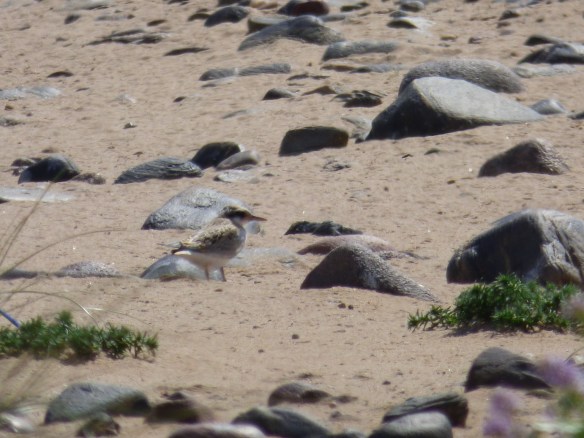
My stock answer to this kind of question is that Forvie doesn’t stop being a nature reserve at the end of the bird breeding season. There are sensitivities throughout the year that require our collective consideration and respect. These include migratory birds trying to catch up on some rest…

…others busily trying to feed up, replacing the calories burned on their epic migration from Arctic to tropics…

…while our resident Roe Deer still have dependent young in tow, and are particularly vulnerable to off-lead dogs.

Meanwhile, the Grey Seal haul-out at the mouth of the Ythan is best avoided, due to the high risk of disturbance and subsequent injury to seals during stampedes. Seal numbers will start to build up again during autumn, with their pupping season taking place chiefly in late autumn and early winter; this is a particularly sensitive time in the Grey Seals’ year.

So the long and the short of it is that there’s never a great time to let the dog run wild on the Reserve! As a special place for wildlife, a much of which rates as nationally or even internationally important, Forvie needs to be treated with a great deal of care and respect right through the year. And I know that I’m probably preaching to the choir in terms of the readership of this blog – but please spread the word!

Speaking of laborious tasks(…), we renewed our hostilities with the invasive Pirri-pirri Bur at Foveran Links this week, turning both the dunes and the air blue in the process. Dealing with this pernicious plant requires a potent herbicide (with blue tracer dye so you know what you’ve already sprayed), a huge amount of persistence and bloody-mindedness, and occasionally some industrial language as befits the chore. Trust me: hiking up and down sandhills while dressed up in a plastic onesie and rubber gloves, and carrying 20 kg of knapsack sprayer, in 25oC of heat, is enough to try anyone’s patience.


Back on the Reserve, the heath is currently looking resplendent in its purple late-summer cloak, with the heather in full bloom. But with many wild flowers now having come to the end of their season, another job for this past week was the recovery of the information boxes scattered around the Heath Trail. Like the ternery fences, these have done another sterling season’s work, and likewise will be retired to the workshop for repair and storage until next spring, when the seasonal merry-go-round turns around once again.


Dragonflies have been in evidence around the Reserve recently, no doubt benefitting from the continuing warmth and sunshine. Most frequently encountered are the small, red- or yellowish-bodied Common Darters, which have a particular predilection for basking on patches of bare sand at the sides of the footpaths.

Occasionally, though, we’re lucky enough to see the much larger Common Hawker on the heath, an impressive beast whose wings make an audible rattle in flight.

Our very own River Ythan made the news this week, ironically for the lack of river. Water levels in the Ythan catchment are extremely low following the exceptionally dry spring and summer, and I’m sorry to say we’re getting desperate for some rain. We did receive a splash on a couple of nights this week, most notably Thursday, and this brought the amphibians out in force. Frogs, toads and newts have moist, porous skins, and can easily dry out in the sort of parched conditions we’ve experienced at Forvie of late. But overnight dew, or in this case a splash of rain, can provide just enough moisture to ease their passage over open country as they move from their breeding pools to their off-season residences, and for a short while until the ground dries up again, they are ubiquitous.


That same splash of rain on Thursday night, allied with an onshore breeze, also delivered our first Continental drift-migrant of the nascent autumn. A sharp piece of spotting by reserve manager Catriona turned up a splendid Barred Warbler in the scrub outside the Forvie Centre on Friday morning. This is an eastern species that doesn’t breed or overwinter in the UK, but instead occurs as a very scarce passage-migrant, chiefly on the east coast and the Northern Isles. Usually stubbornly skulky and hard to observe, this particular individual bucked the trend and proved surprisingly and delightfully obliging. As such, he quickly acquired the affectionate (and predictable) name of Barry from the admiring Reserve team.

With August having generally been a quiet month on the bird front, Barry was a most welcome visitor indeed – and hopefully the harbinger of an exciting autumn to come over the course of the next three months. Bring it on!




 Forvie National Nature Reserve